Service95
The True Cost Of Denim | Celebrating Neurodivergent Artists | The ‘Big, Black And Queer-Ass’ Theatre Production That Will Reveal A Lot About You

#024 Service95 #024 Service95 #024 Service95 #024 Service95
|
Into The Woods, Matthew Murphy, Evan Zimmerman for MurphyMade; The Glass Menagerie, Johan Persson; Richard III; POTUS, Paul Kolnik; Jerusalem, Simon Annand |
My Return To The Theatre (Audience)I miss live theatre dearly. Though I’ve not been able to see any proper shows in so long – tour life and the like! – my friends and Service95 writers (such as Justin Kirkland in his Michael R Jackson piece this week) have kept me in the loop, so I’ve been eagerly compiling a list of productions to go to during my ‘off-season’. There’s no thrill nearly as electric as the connection between live performer and audience – which I know well – so I’m beyond excited to be on the other end of the equation in the months ahead. Here’s what I’ll be seeing… Dua x
|
|
Marc J Franklin Photos |
The Award-Winning Musical That’s A Cocktail Of Humour And DiscomfortWhen Michael R Jackson pops up on Zoom early on a Monday morning, he’s oddly serene considering his debut musical A Strange Loop is up for 11 Tony Awards. By the end of the same week, the production – dubbed a ‘Big, Black, and Queer-Ass’ American musical – will have won two trophies, including the crowning glory, Best Musical. The dream that took 18 years to create will be met by a literal and figurative standing ovation, proving there’s plenty of room for a production that dares to be different. The show shakes off the cobwebs of the Great ‘White’ Way, offering a respite from the family-friendly titles that often dominate its theatres. “I think there’s certainly value in, ‘What a great show. Let’s go have a piece of pie,’” Jackson admits. “But I think it’s also great if you’re like, ‘Wow, I’m thinking about that a week later.’” A Strange Loop is much more the latter: it’s a musical written by a queer Black man, writing a musical about a queer Black man, writing a musical about a queer Black man. It’s self-referential, without being autobiographical; distinctly specific yet universal. And it’s not apologising for being as blunt as the backend of a Bible upside your head. The show tackles everything from racial prejudice and explicit sex to Tyler Perry and fatness, but when Jackson is asked if he was worried about overwhelming audiences with a buffet of touchy subjects, he flashes a smile and says, “I was never worried about sharing it with anyone because I’m kind of an oversharer by nature.” It mustn’t hurt that people seem to like what he’s sharing, with the show’s long list of producers including A-list talent from RuPaul to Alan Cumming. Set in the mind of the main character named Usher, he and his six thoughts explore the ‘strange loop’ of Usher’s consciousness, with the six thoughts becoming machinations that range from ‘daily self-loathing’ to Usher’s perceptions of his hyper-masculine father and Bible-thumping mother. The show mixes comedy with frank social commentary (such as the clap-along the audience is roped into during the number Aids Is God’s Punishment), leaving viewers with a bizarre cocktail of humour and discomfort. “I just really wanted to send that up on fire,” he says, speaking of the show’s tone, particularly when it comes to the subject matter of how religion is used against queer people. “The reality of it is that it’s not just that it’s homophobic. It’s that it all sounds so good.” At 41, Jackson’s A Strange Loop would be one hell of a Broadway origin story, if he weren’t so entrenched in the business already. Like Usher, Jackson worked on Broadway as an usher at The Lion King and Mary Poppins for years before his own show made it to the stage. A graduate of New York University’s Tisch School of the Arts and a lifetime theatre fan, his brilliant work is his opportunity to create something for theatre lovers that, despite being beautifully Big and Black and Queer-Ass, feels oddly familiar. At the core of A Strange Loop, there’s you – like, literally you, the observer. Jackson taps into something unnervingly honest about being in your own head. “I felt unseen, unheard, misunderstood,” he explains. “If other people connect to that… then we get to feel not so alone together.” As Jackson notes, he’s had people from all walks of life say that they relate to Usher’s doubt, anxiety, and self-reflection. “Joni Mitchell has this great lyric,” he says, looking up to remember the words of one of his “white girl music” inspirations. “It all comes down to you. No matter what else is happening, it all comes down to you.” That’s half the beauty of A Strange Loop because when it’s over, the biggest twist of the show is what it reveals about you. Justin Kirkland is a Brooklyn-based writer whose work has appeared in Esquire, Vulture and USA Today |
|
ARTXVNFT; Sweetest Pie, J Quinn; Watermelon Sugar, J Quinn; No Mans Land, Caleb Lewis; Journey, Ava Halvai |
ARTXV: The First-Ever NFT Collective For Neurodivergent ArtistsMarie-Claire Chappet Ava Halvai is one protective sister. During last year’s lockdown, the British-Iranian computer science student decided to help her autistic, non-verbal sister Tara break into the art world. The result inspired something extraordinary: the launch of ARTXV, the first-ever NFT (a completely unique virtual asset) collective for neurodivergent artists where neurodiversity is readily included and championed. “Tara can’t really advocate for herself,” Halvai explains. “When I tried, the reaction was that people loved the art but stepped back when they found out she was autistic. I wanted to change that.” And so she began ARTXV as a simple Instagram page – and now promotes 16 neurodivergent artists. “They all had the exact same experience as my sister. I think people will be shocked by how conservative and archaic the art world really is.” The NFT aspect of the collective means it is democratic and inclusive. “It gives you the ability to just go online, form connections… You don’t have to break into the elite circles of the art world in ways that are often impossible for neurodivergent people,” she says. “NFTs are a kind of counterculture, where they’re rejecting these old systems.” The collective’s first ‘drop’ happened last month and Halvai has also secured a partnership with Google Arts and Culture – the first art collective of its kind to do so. Yet Halvai’s ambitions extend beyond NFTs. Her desire is to create neurodiverse-friendly studio spaces for her artists and open the world of fine art to the possibility and credibility of neurodivergent artists. When she initially established her collective, Halvai was told to make it a charity. She rejected the premise. “Neurodivergence is power, and it is a misunderstood one,” she says. “These aren’t people who need charity. These are artists who need the world to see their art.” Marie-Claire Chappet is a London-based arts and culture journalist and contributing editor at Harper’s Bazaar |
Coveteur/Trunk Archive |
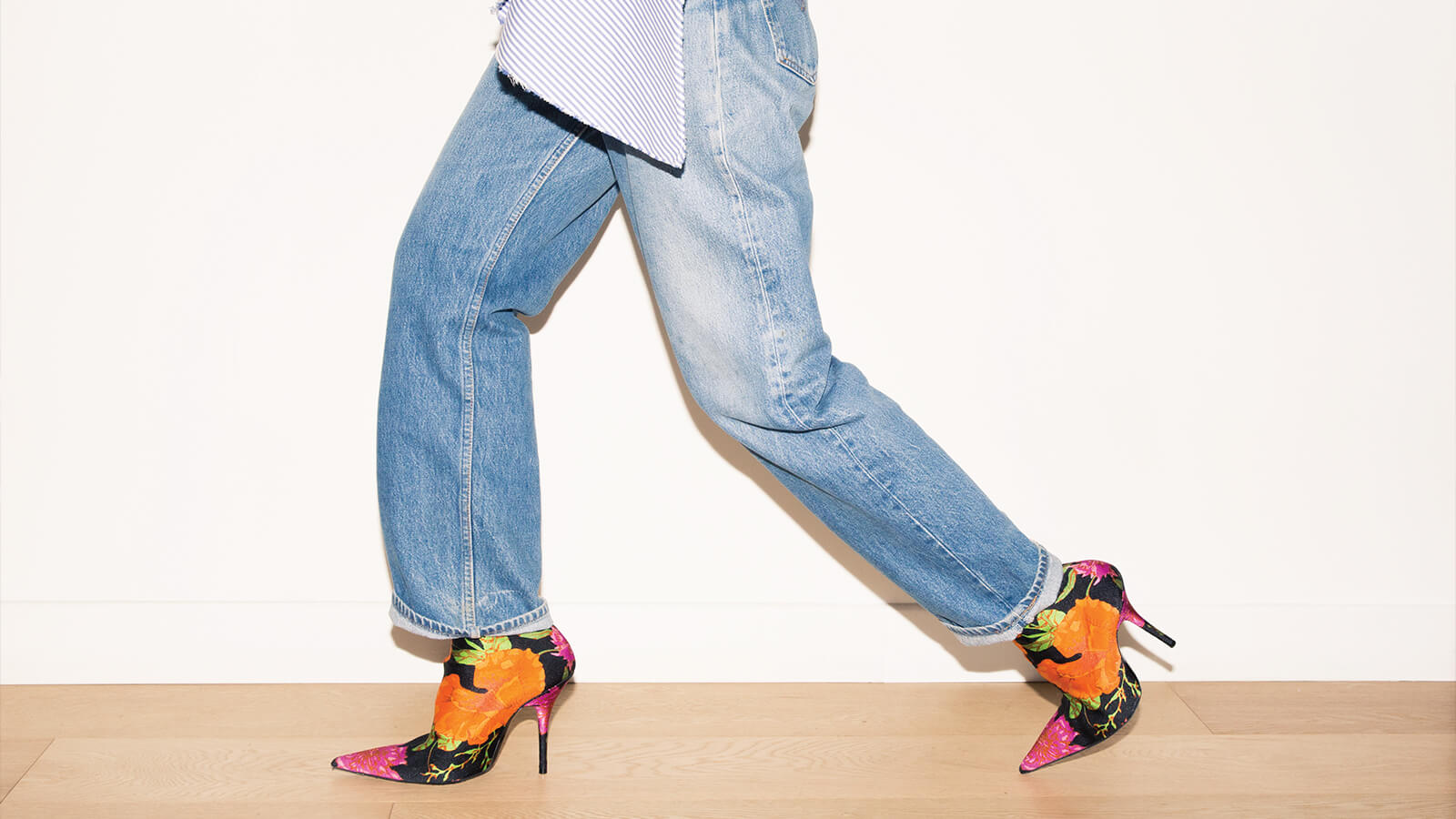
How We Can Counteract The Social And Environmental Harms Of DenimSophie Benson Jeans are the ultimate wardrobe staple. At any moment, around half the world’s population is wearing them, and billions more are sold each year. Denim sales slumped during the pandemic but now they’re back and booming, with searches for jeans up 23% in 2021 and denim looks dominating both the AW and SS fashion weeks. The main ingredient of the essential ‘jeans and a nice top ’combo might seem innocent enough, but denim manufacturing is a source of significant environmental and social harm. Let’s start with what makes denim, denim: the iconic blue colour. Although originally natural indigo was used to dye denim, cheaper petroleum-based synthetic indigo replaced it in the early 1900s and now the denim industry uses over 40,000 tonnes of it per year. And chemicals such as formaldehyde and cyanide are in the mix too, used during production to make the dye itself and prevent bacteria growth and staining. If all those chemicals are released into local waterways after manufacturing, they can starve aquatic life of oxygen, killing the natural ecosystem – and the issue with water doesn’t end there. Levi’s found that a single pair of 501 Jeans uses as much as 3,781 litres of water in a lifecycle, and one pair of used jeans can release around 56,000 microfibres per wash. If you love the worn look, your jeans may have been sandblasted, which is a process that can cause workers to contract respiratory issues and silicosis – a long-term lung disease caused by inhaling large amounts of abrasive silica dust. We often focus on nature because the climate crisis is, for obvious reasons, at the front of our minds, but workers should always be centred too. Cotton, which denim is made from, has troubling, inescapable links to Uyghur forced labour. It is estimated that more than one million Uyghurs – the largest minority ethnic group in Xinjiang, China – have been detained in ‘re-education camps’ and as many as one in five cotton garments are linked to forced labour in the area. So do we give up on denim? Not necessarily, but we do need to pay attention and put pressure on brands and retailers who have the power to make things better. And, thankfully, some are already putting in the work, creating a lower-impact denim industry better fit for the future. Here are five brands and innovations to have on your radar:
Sophie Benson is a freelance journalist covering fashion through the lens of the environment and human rights. She’s the sustainability columnist for Dazed and writes for publications including Vogue, AnOther and i-D |
Service95 newsletters are available in multiple languages. Choose your preferred language here:
Service95 Weekly Newsletter © London, UK |
|
Was this email forwarded to you by a friend? You can subscribe here. If you no longer wish to receive emails from Service95, you can unsubscribe here. |