

What Litmus Live 2026 actually taught us about email
AI email relevance is reshaping deliverability, engagement, and trust. These are the ideas worth carrying back from two days of email talks.


Here's the thing about email conferences: the most useful moment is rarely the keynote. It's the sentence a panelist throws away mid-thought that you write down while pretending to take normal notes. Litmus Live had several of those moments. It also had the usual stuff — benchmark slides, brand case studies, panels where everyone agreed with each other. We're going to skip that part. What follows are the ideas worth carrying back to your desk.
Permission used to guarantee visibility. It no longer does.
Gary Vaynerchuk reminded everyone that in 1998, his Wine Library emails hit 83% open rates. Not because he was a genius. Because the channel was new, uncluttered attention, and nobody had figured out how to ruin it yet.
We ruined it.
But he's cautiously bullish again. His call: a 20–40% open rate lift is sitting there for senders who figure out AI driven relevance in the next couple of years. Not because email is getting easier. Because the field is about to thin out, and the gap between sharp programs and "we've always done it this way" is widening.
The mechanism: Gmail's Gemini integration, Apple Intelligence's digest view, Yahoo's relevancy sorting. The mailbox providers confirmed it in their panel. Your email isn't competing with other emails anymore. In Danielle Gallant's words, it's competing with an AI's selection — a judgment about whether a human actually wants to read it. When attention was unlimited, and inboxes were empty, any signal got through. Now there's a filter between send and seen that's trained on real engagement behavior. What gets through isn't what you want to send. It's what your subscribers have demonstrated they actually value. The inbox didn't get harder. It got honest.

If your email can be compressed into a one-sentence summary without losing anything, design for that. Lead with the thing that matters. If the value isn't in the first two lines, it might not matter where the value is.
When AI makes everything faster, slower thinking becomes an advantage.
Ann Handley (MarketingProfs) opened with a Mighty Mouse cartoon. Stay with it. Her villain: the cow. Fast, efficient, dashboard-friendly. The cow is what you become when AI turbos your existing instincts — more sends, faster production, metrics that look great on a slide, and quietly hollow out the relationship with your audience.
Her hero: the sloth. Slow. Deliberate. Aimed. Nobody gives the sloth a budget line. Nobody walks into a planning meeting and says, "Let's do this slower so it actually works." They get laughed out of the room, or as Ann put it, metaphorically thrown in prison. Her name for why the cow wins anyway: the performance paradox. We measure what's easy to see. So we optimize for what matters least. Clicks. Volume. Send frequency.
Things that look like progress and compound into nothing. Her data point: Nike's newsletter "In the Margins" launched with roughly 2,000 subscribers. No press release. For Nike. Her read: intentional. They're winding up before they slam. "The sloth's superpower isn't the slam. It's the windup." Performance signals are easy to measure. Relationship signals are easy to ignore.
The problem is that relationship signals are what actually predict whether someone opens your email eighteen months from now, and performance signals are what get celebrated in the weekly standup. Before your next send, ask: does this grow who we are, or just what we ship?
90% of email is malicious. Your deliverability anxiety is probably a misdiagnosis.
Dan Givol (Google), Ross Adams (Microsoft), and Marcel Becker (Yahoo), moderated by Guy Hanson, said the thing nobody usually leads with: 90% of email on the internet is genuinely malicious. Their filters aren't built to stop your campaigns. They're built to stop actually dangerous stuff, and legitimate senders get caught in the blast radius.
That reframe changes how you debug problems. Many deliverability issues aren't about bad actors. They're about being indistinguishable from them. A few things worth keeping from that conversation:
Sender reputation: Think of it like being a bar regular. One bad night, nobody throws you out. But keep picking fights with the staff, keep alienating the room — the memory sticks. No amount of apologizing the next morning fixes it. Reputation isn't reset by good intentions. It's reset by sustained behavior.
Gaming AI summaries: Don't. Hidden text, prompt injection, invisible content designed to influence how AI reads your email — it's already being detected and penalized. "Just send the right content with the right words." Boring advice. The only advice that ages well.
Reply rate as a primary KPI. Opens are unreliable. Clicks are getting murkier. A reply is an unambiguous human act. If you're not designing emails that invite a response — a real reply-to address, actual questions, treating the channel as a conversation — you're ignoring the cleanest engagement signal available.
DMARC is moving from nudge to enforce. Al Iverson (Vailmail) and Becker both said it independently. p=none isn't going to hold much longer. The providers run the same playbook with every mandate: educate, nudge, enforce. Start the conversation now while there's runway.
And the BIMI connection is worth making explicitly. Getting to a DMARC reject policy unlocks logo display in the inbox. Virgin Atlantic's Tom Nowell and Reece Cohen reported meaningful click-rate uplifts since their logo began appearing before the open. The authentication work pays dividends in more directions than one. Their advice for getting it funded internally: connect it to revenue and NPS, not technical compliance. Nobody gets a budget approved by talking about DMARC.
AI is making everyone's emails sound the same. Here's the escape route.
Jay Schwedelson (Outcome Media, SubjectLine.com) delivers talks the way an auctioneer delivers bids. Here are the ones worth your attention. The word "unlock" appears in one out of every eight subject line suggestions for B2B prompts. "Upgrade" in one out of nine for the consumer. "Join" in one out of six for a nonprofit. These words aren't bad. They're wallpaper.

When everyone uses the same tool with the same prompts, they all get the same email, and your differentiation dissolves. When a stimulus is repeated often enough, the brain stops registering it. The solution isn't a better word. It's a different approach to prompting.
The 100,000-person prompt. Instead of asking AI to "write me a subject line," ask it to "predict how 100,000 real subscribers would respond to these subject lines and rank them by expected open rate." This shifts the model from creative mode to statistical mode. His team found that it outperformed standard prompts 70% of the time. Worth 30 extra seconds.
Recency signals for AI search. AI citation sources are, on average, 393 days newer than Google results. Content with a specific date or time reference in the title is 53% more likely to appear in AI-generated answers. Your buyer is now researching in ChatGPT and Perplexity before they ever find your website. The simplest fix: rename your evergreen content. "State of HR Laws" becomes "State of HR Laws: Q1 2026." Same content. The AI finally sees it.
Continuation preheaders. Starting your preheader with 'and', 'but', or 'plus' keeps the reader moving from the subject line instead of stopping. Tested at roughly a 19% open rate lift.
Your bounce file is a lead list. The email address bounced. The person didn't. On the B2B side: extract domains and run ABM campaigns to other contacts at those companies. On the consumer side, find them on social media. Bounces aren't a closed door.
The meta-lesson from Schwedelson's session isn't any individual tactic. It's that the whole game right now is escaping the gravity of everyone using the same AI tools the same way. Test more. Prompt differently.
Accessible emails perform better. That's not a coincidence.
Lauren Castady (LC Creative) and Tylor Loposser (Zeta Global) made a reframe worth holding onto.
The conventional framing: accessibility is designing for a small segment of users with declared disabilities. The more useful framing: 100% of people experience situational or temporary impairments. Cracked screen. Bright sunlight. One hand occupied. Cognitive overload at the end of a long day. When someone looks at an email and thinks not right now — that's not a motivation problem. That's a friction problem. And it shows up in your metrics as a silent blocker before any click or conversion has a chance.
There's an estimate of $16.8 billion in global e-commerce revenue lost annually, not because people won't buy, but because they can't access the experience well enough. Friction before action kills action.

We spend a lot of time optimizing the offer, the creative, and the subject line, but leave unnecessary friction in the experience that turns people away before they get there.
Their McDonald's Minecraft email example was clear: alt text reading "Visit McDonald's, home of the Minecraft Movie Happy Meal" instead of just "McDonald's logo." Same brand. Same branded tone of voice. Accessible to anyone navigating with a screen reader. Not a compliance checkbox — an extension of the creative.
The practical role-by-role breakdown:
- Designers: Build a color contrast matrix showing which brand color pairings pass and which fail. This removes subjectivity from reviews and makes accessibility a default, not a debate.
- Developers: Language tags, logical reading order, live HTML text over flattened images, bulletproof buttons. None of these requires a redesign.
- Copywriters: CTAs that describe what will happen. "Reserve my stateroom" outperforms "Reserve now" for everyone — more accessible and more persuasive.
- Managers: When someone in a critique says, "I can't read this easily," that's data, not preference. Treat it that way.
Accessibility isn't designing for the margin. It's removing friction for everyone, then discovering that removing friction for everyone is exactly what the margin needed to.

AI can scale your email program. It can also scale your mistakes.
Rafael Viana (Validity) moderated Leah Miranda (Zapier), Larry Kim (Customers.ai), and Beth O'Malley (astral) in the session where the disagreements were actually worth watching.
Beth's argument: AI might be scaling bad emails. If your strategy was shaky before, AI gives you the ability to execute that shaky strategy faster and at higher volume. When a subscriber feels an email doesn't read like the brand they expected, they check out. That association is hard to reverse. And you can end up accelerating the wrong things.
Larry's counter: The real problem is how we're using AI — piecemeal, for one part of the process, without full feedback loops. His stat: 2% of e-commerce sends generate 50% of e-commerce revenue. Those 2% are triggered by real intent signals — product abandonment, funding events, job changes — not calendar schedules. The future isn't smarter newsletters. It's AI listening for the right moments and sending them.
Leah's position: somewhere in the middle. Her team at Zapier built agents that pull real product usage data from Databricks and select the most contextually relevant CTA for each onboarding email based on what the user actually did in-product. Meaningful click-through improvements. No large engineering team required. But she agreed with Beth: the same capability can be used to do something much dumber, faster.
Near the end, Leah mentioned that if you've emailed her recently and got a response, it was probably drafted by one of her AI agents. Her personal inbox is managed by agents that surface only what matters — discount code: yes/no; trying to sell something: yes/no — and she rarely opens the actual emails. The implication isn't hard to see: we are building automated sends that are increasingly being read by automated inboxes. Humans review summaries at both ends. Email has always derived its power from feeling one-to-one. If the receiver's AI is filtering your sender's AI's output, the brands that hold up are the ones that built genuine subscriber engagement before the agents took over. Trust is infrastructure. It doesn't get built at the last minute.
A few things that are easy to miss and expensive to ignore.
Time-based B2B automation doesn't track intent
Jeanne Jennings (Email Optimization Shop) created this case study: a B2B financial services client whose series was escalating pressure on a time-based schedule, regardless of where anyone actually was in the decision-making process. Rebuilt with value-first content and stage-based messaging that adjusted to real signals. The result: 300%+ lift in revenue per thousand emails sent, plus a shift toward annual plan conversions over monthly. The emails stopped chasing time. They started tracking readiness.
The second purchase window matters more than most programs treat it
Jimmy Kim and Chase Dimond had one number worth keeping: customers who purchase a second time within 30 days are three times more likely to become repeat buyers. Most programs have almost nothing automated in that window. If there's a gap between the first purchase and the next send, you're hoping for repeat behavior instead of building toward it.
Personalization means using data to decide what to send, not what to say
Jay Oram (ActionRocket) flagged a common misconception: teams think personalization means printing data into the email body — first name, birthday, "we saw you looking at these shoes 30 minutes ago." That's where the thinking gets stuck, and where it starts feeling creepy. The data is almost always more powerful when used upstream: to segment, trigger, or tailor who gets what. The email itself doesn't need to show its work.
Your emails are probably bigger than you think, and your buttons smaller
A live optimization session — Mark Robbins, Danielle Gallant, Julie Stuck, and Megan Farquharson — reviewed attendee-submitted emails in real time and found the same two problems in every single one. File size: Gmail clips anything over 102KB, and ESP-injected tracking attributes you didn't write and can't see in your editor are quietly adding weight. One email dropped from 141KB to 68KB with zero visual changes after cleanup. Buttons: only the text is linked, not the padding. Users click the visual button, nothing happens, and they assume it's broken. Styling the tag directly, rather than the wrapper, fixes it. Neither problem is exotic. Both are apparently everywhere.
The tools got cheaper. The judgment became more important
Every session was circling the same problem from a different direction. AI has made speed cheap, scale cheap, and content cheap. And cheap, fast content flowing through an inbox mediated by AI is a reliable path to invisibility. The programs that do well aren't the ones automating fastest. They're the ones using the speed to do more considered work — more deliberate creative, more honest relationship with the list, more willingness to build slow and let it compound. Ann Handley put it plainly: When speed is cheap and abundant, judgment carries a premium. The tools are table stakes. The judgment is the job. Go be the sloth. 🦥
One more thing
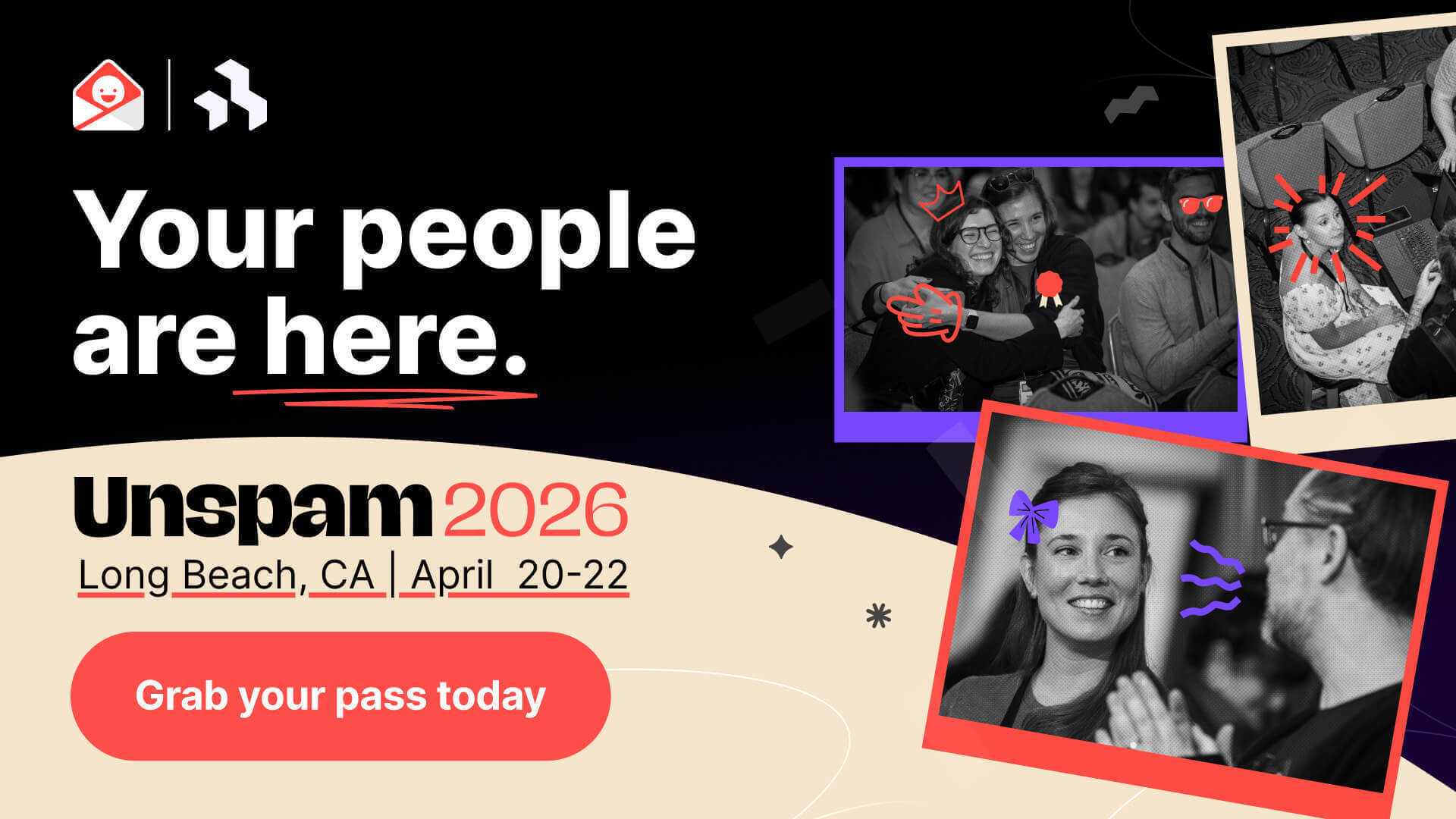
If you want more of this (email geeks stuff), Unspam is in Long Beach this April. Unspam is Really Good Emails’ unconference - under 250 people, April 20-22 at the Hyatt Regency Long Beach. First time on the West Coast.
A recap is good for information. An in-person event is good for the stuff that doesn’t make it into the recap: the hallway conversation that reframes a problem, the people you’ll actually email when you get home. Unspam is deliberately small because the value is in the room. 9.2 out of 10 attendees say they’d recommend it. Most come back.
Tickets are limited and sell out. If you’re thinking about it, don’t wait. Get your ticket here.
Articles to whet your whistle



Subscribe to our newsletter.
Dive into the world of unmatched copywriting mastery, handpicked articles, and insider tips & tricks that elevate your writing game. Subscribe now for your weekly dose of inspiration and expertise.