

Why accessibility matters even more in the AI world
Accessibility is now a legal, technical, and AI readiness issue. Cyrill Gross at Unspam 2026 explains why your next email needs to work for machines too.

Cyrill Gross opened his talk at Unspam 2026 with a word cloud. Everything accessibility-related was in there: alt text, screen readers, WCAG, lang attribute, semantic HTML, European Accessibility Act, and ADA. Lots of terms. One persistent problem: in most companies, the accessibility conversation dies before it starts.
Finance says no to the budget. Management says, "We'll do it later." And the email team keeps shipping nested tables and CTAs that say "read more."
Gross, an email developer for nearly 18 years and founder of mailix, came to Unspam 2026 with one goal: give you the argument that actually works in a budget meeting. Not accessibility as a nice thing to do. Accessibility as a technical, strategic, and legal necessity.
Screen readers and AI are not the same thing
This is the most important distinction in the talk. And probably the one that fewest people had already thought through.
A screen reader reads your email as-is. Top to bottom. No context. No memory of your relationship with the brand. It helps the user navigate.
An AI assistant or agent does something completely different. It understands the content. It analyzes it. It knows what you bought last week. It knows the last five emails you received from that brand. It can summarize, filter, and in some cases make decisions for you before you ever open the email.
Gross tested Gemini in Gmail earlier this year: he asked the assistant what the latest road bike offers were in his newsletters. Gemini ignored the emails and searched the internet instead. Gross pointed out the problem and asked what a brand could do to be found in emails. The answer Gemini gave was essentially an accessibility checklist.
When he ran the same test a few days before Unspam, with an updated model, the result was completely different: a list of bikes with prices, referencing the specific emails where the offers were found. In a month and a half, the leap was already significant.
The direction is clear. People will tell their AI assistant to buy them a bike at the best available price. If your email is not machine-readable, you do not exist in that transaction.

Assistant vs. agent: the distinction that matters
An assistant is on demand. You call it, it responds. It supports decisions.
An agent is automated. It acts on its own. It can make decisions without user involvement. You can already configure Claude to purchase a product whenever it goes on sale. The agent does it. You do nothing.
Which means your emails do not only need to persuade people. They need to persuade the machines reading on behalf of people.
The legal case is already here
If you are still selling accessibility as "the right thing to do," you are losing the argument before it begins.
The legal framework exists. In the US, there are active lawsuits for ADA violations in digital products. Canada has the Accessibility Canada Act. And in Europe, the European Accessibility Act will come into force within about a year. Digital processes are in scope. Email is part of digital processes.
For large enterprises, legal teams are already paying attention. For second and third-tier companies, they will be soon.
The question to put to the naysayer is not "can we afford to do this?" It is this: who takes responsibility for the performance decline and the lawsuits if we do not?
The business case has numbers behind it
Around 25% of the population has some form of disability. Visual, cognitive, linguistic. Litmus published research on this earlier in 2026. And studies show a correlation between accessibility and improved KPIs.
This is not just doing the right thing. It is doing the thing that converts.
Start with the envelope
Accessibility starts before anyone opens your email. It starts with the sender.
Sender name, subject line, preheader
Gross cited the "John from Johnson" case that circulated a few years ago: customers calling to speak to this person, who often did not exist, and getting angry when they could not reach them. The sender's name should identify who you actually are. The subject line should state what the email is about. The preheader can do something more useful than a second subject line: try a comma or pipe-separated list of the main topics in the email. Gross has seen open rate lifts with this approach.
No-reply is not a from address
A "no-reply" in the from address explicitly says: I do not want to talk to you; I just want to send you stuff. Use real addresses. Updates@, welcome@, latestnews@. They give context. And with AI-controlled inboxes arriving, that context matters more than ever.
Kill the tables
As of 2026, one single client still relies on tables for layout: classic Outlook. Every other email client handles divs just fine.
Tables were not designed for layout. They were hijacked for that purpose during the browser wars around the turn of the millennium. The result is heavy code, painful responsive behavior, and more clipping.
What to use instead
- Use divs and semantic code
- For Outlook, ghost tables in MSO conditionals. Problem solved.
- Use section, header, footer, and main to structure content
- H1 once. H2 and H3 where they belong. Same rules as SEO.
- Strong and em instead of b and i: they carry meaning, not just shape
- Declare the lang attribute. A screen reader trying to read English in Spanish because the phone is set to Spanish produces something genuinely incomprehensible.
Cleaner code also means less clipping. Gross noted that the overhead from tables often outweighs the extra code needed for interactive elements.
Humans need visuals. AI needs structure. You need both.
This is the new tension Gross put on the table.
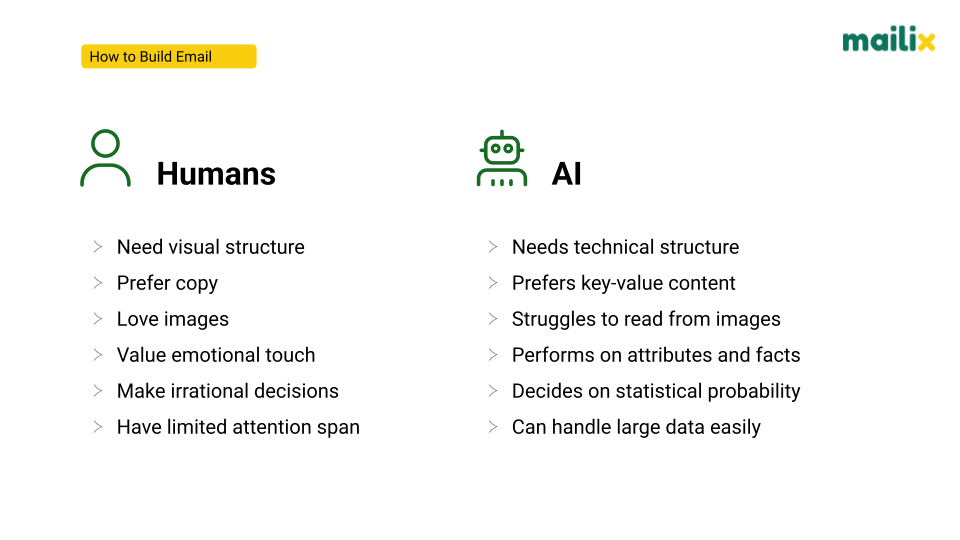
Humans want visual structure, well-written copy, and images. They make emotional decisions. They have limited attention spans. They respond to things that feel human.
AI needs a technical structure. It prefers key-value pairs. It needs facts. It does not analyze the image: it works from the attributes and data in the code.
How to serve both at once
Gross showed an interactive email for a German retailer: up to 50 products navigable by category, visually polished for humans. To make that data machine-readable, they added interactive panels with key-value lists of each product's attributes. Visible to the user if they want to click through, invisible if they do not, always present in the code for the AI.
JSON-LD is another tool worth considering. Google supports it, and there is a reasonable chance Gemini responds positively to emails with product data structured in that format.
The one slide that matters
Gross closed with a single sentence to address the naysayers: accessibility is no longer a woke or DEI issue. It is a technical, strategic, and legal necessity.
Hand it to whoever controls the budget. Tell them to sign off on it, or take personal responsibility for the performance decline and the lawsuits.

Where email goes from here
The final section of the talk was personal, declared upfront as a prediction rather than research.
Gross expects email to become a key tool for influencing AI assistants and agents, precisely because it is the only push channel that delivers high volumes of content. Every other channel requires pull. Email arrives on its own.
On the technical side, he expects stricter standards for structured data in email. JSON is already everywhere. There is also talk of TOON, token-oriented object notation, essentially JSON without the structural overhead. He does not know if it will catch on, but it is where the conversation is heading.

On the human side: no, people will not delegate every decision to AI. Would you buy a car without looking at it? The curiosity, the desire to go deep on something yourself: that is a human characteristic that does not switch off. Gross wrote his bachelor's thesis in 2009 on email. His conclusion, at the height of Skype, Twitter, and SMS, was that email would not die. It would clean itself up. That is exactly what happened.
His prediction now is the same: email does not die. It adapts. And the people who know how to build emails that work for both humans and machines will be in a position that is genuinely hard to replicate.
Articles to wet your whistle



.png)
Subscribe to our newsletter.
Dive into the world of unmatched copywriting mastery, handpicked articles, and insider tips & tricks that elevate your writing game. Subscribe now for your weekly dose of inspiration and expertise.