

How to write emails expert audiences actually trust
Eight years of writing emails for scientists and engineers taught Hannah Castellanos one thing: the tactics that work on everyone else will quietly destroy trust with experts.

You sent an email to an expert this week. Maybe you called it industry-leading. Maybe you added urgency. Maybe you wrote "our customers love us" and moved on. The person on the other end spent fifteen years in their field. They noticed.
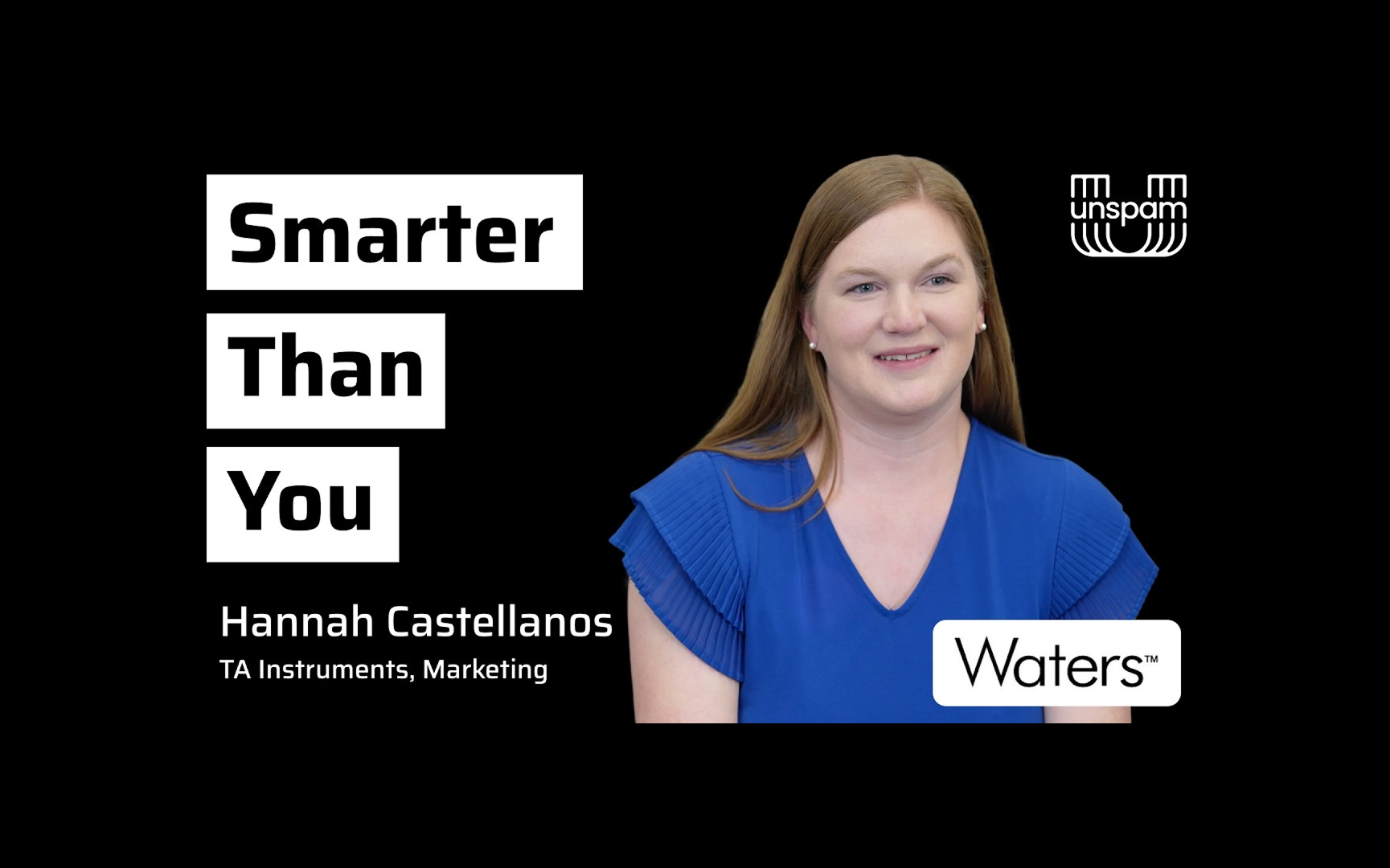
Hannah Castellanos has spent eight years writing emails for scientists, engineers, and PhD researchers at Waters Material Sciences Division (formerly TA Instruments, sad face, her words). They make analytical technology that measures lithium-ion battery safety, pharmaceutical properties, and the rubber in the tires that help your plane land. Her audience knows what a cathode is. She did not, at first.
At Unspam 2026, she took the stage as Marketing Automation Campaign Manager and made a case that goes well beyond scientific markets. Her talk was officially titled "Writing email for people smarter than you." And while her situation sounds niche, her point is not. In some way or another, most of us are writing for an expert audience.
Here's what eight years of writing for scientists taught her. And why most of what you know about email marketing stops working the moment your reader knows more than you do.
Experts are not looking to be excited. They are looking for a reason to trust you
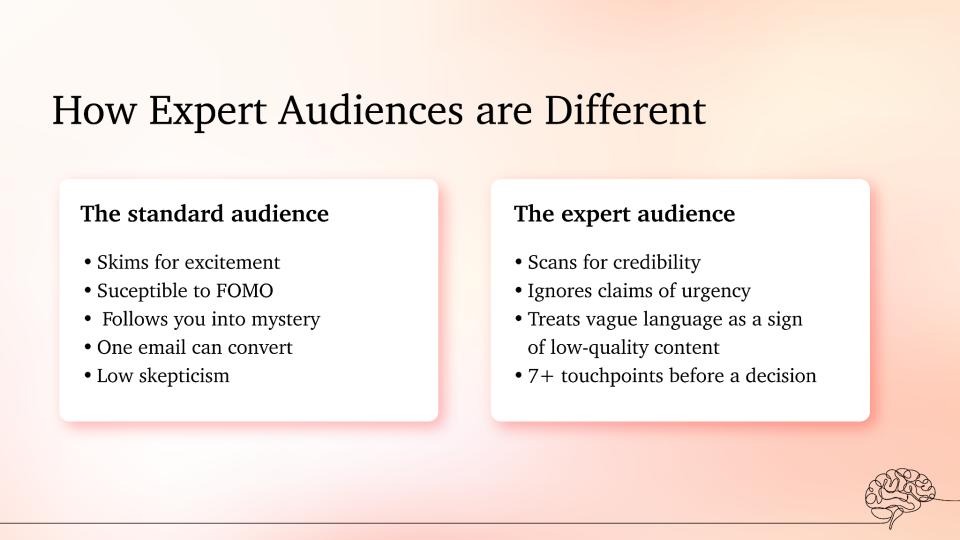
Most email marketing is built for a general audience. Someone skims a subject line, gets a little FOMO, clicks in, and buys something. One touchpoint can do it. Urgency works. Mystery works. A big "game-changing" adjective works fine.
Then an expert lands on your content.
They are not skimming for excitement. They are quietly auditing everything you say against what they already know. Do you have credentials? Do you signal that you understand the subject? Or are you just using vague marketing language and hoping they do not notice?
(They notice.)
They also take much longer to convert. Experts require many more touchpoints before making a decision. Trust is earned over time, not manufactured with a countdown timer.
Two flavors of experts, and what kills trust with each
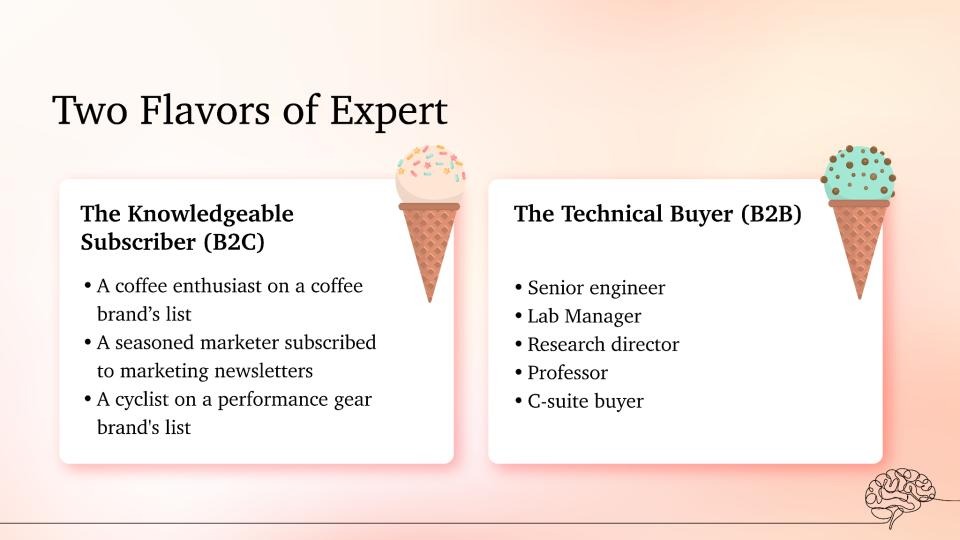
Knowledgeable subscribers ("vanilla sprinkles," she calls them) are your B2C experts. A coffee enthusiast on a coffee brand's list. A CFO reading a finance newsletter. They come to you as a source in their area. Oversimplify, and they notice. Retitle your 2024 trends piece as 2026 without updating the content, and they are gone. What builds trust: specificity, acknowledging their expertise, and writing to them as a peer rather than a student.
Say you work for a creative software company and you are writing to a senior brand designer who has been using your tool for twelve years. Telling them "this platform makes it easy to create stunning vector graphics" is the email equivalent of explaining to a chef how a knife works. They do not want the basics. They want to know how your new AI features fit into their actual workflow, or what the non-obvious uses of a new feature are. Give them the level-up, not the tutorial.
Technical buyers ("adult mint chocolate chip," obviously) are your B2B experts. Senior engineers. Lab managers. Research directors. People who have watched a hundred products get labeled "revolutionary" and then disappear two years later. (She makes a phone analogy here. You know the one.)
Urgency actively backfires with them. If your customer has a 24-month procurement cycle that involves procurement, multiple quotes, and a board committee, your "buy before the end of Q2" email is not motivating. It is insulting. They do not rush. They dismiss you.
What builds trust with technical buyers: technical precision. White papers. Case studies. Data. Content that acknowledges the real bottlenecks in their workflow and offers solutions. Every email is an audition. Are you worth their time?
Vague language is the problem. Evidence is the solution. But not all evidence is equal
Here is the writer's instinct trap: when you do not fully understand a product, you reach for bigger adjectives. "Game-changing." "Cutting-edge." "Industry-leading." Or you use social proof where specific proof would land harder: "our customers love us" instead of "87% of customers are repeat buyers."
Experts see through this immediately. They have spent careers evaluating claims. They know the difference between sounding convincing and actually being convincing.
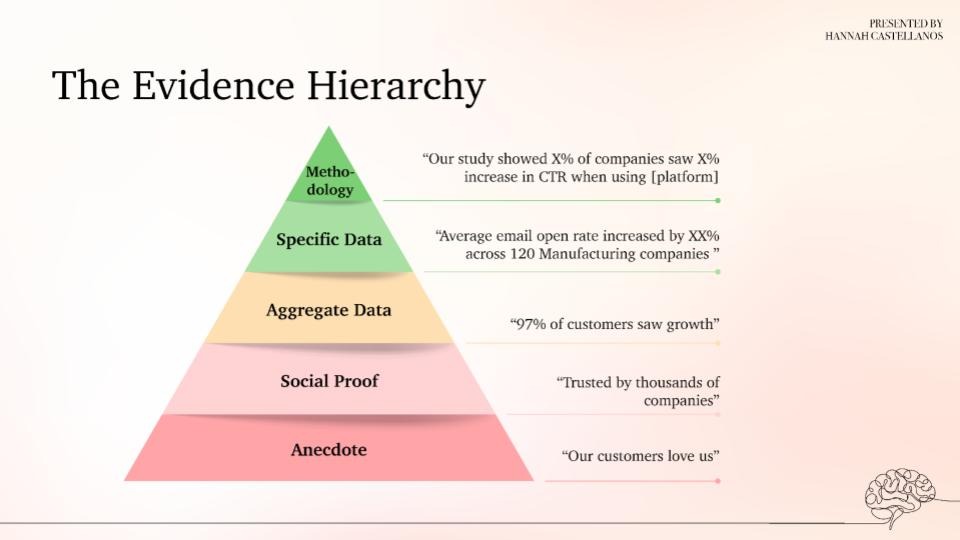
Castellanos introduces the evidence hierarchy, a five-level pyramid. The goal is not to use it all at once. It is to find one sentence in your next email and move it up one level. (Just one. That is the whole exercise.)
- Anecdotal evidence sits at the bottom. "Our customers love us." Technically a statement. Does nothing for trust.
- Social proof is next. "Trusted by thousands of customers." Softer than it sounds. Still vague.
- Aggregate data adds a number. "97% of customers saw growth." Now you have something.
- Specific data adds context around that number. A percentage, a number of companies, an industry vertical. "Average email open rates increased by X% across 120 manufacturing companies." Getting warmer.
- Methodology is at the top. A real study, a defined method, specific result. The most credible thing you can publish. And, yes, the hardest to get. Worth it when you can.
She calls the practical version of this the evidence swap: find one claim, find one data point that backs it up, swap the vague version for the specific one. Legally supported, please. She says this with the energy of someone who has had the legal conversation. And do not bury them in data. One strong evidence point per email builds more trust than a dashboard's worth of numbers nobody asked for.
Experts rarely convert on one email. So you need a system, not a blast
This is where nurture programs come in. Castellanos is very pro-nurture for expert audiences (behavior-based nurtures are "the bomb.com," direct quote).
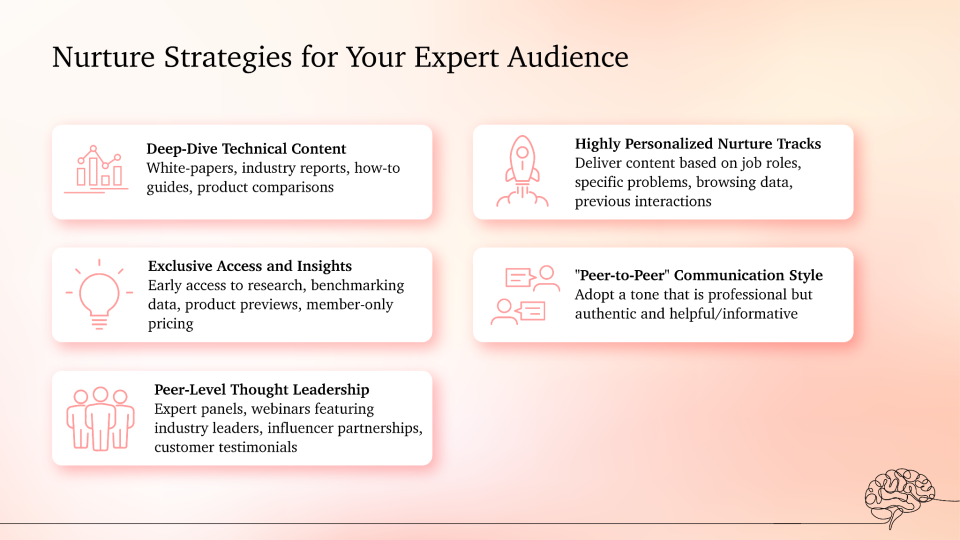
Her structure has three stages. Awareness and credibility first: a few emails introducing your company, the problem you solve, and the bottleneck you address. Blogs, how-to guides, and infographics. Introductory, but specific. Then, consideration and evaluation, deliberately the longest stage. Webinars, expert panels, case studies, white papers. The content that actually convinces. Finally, decision and conversion: product comparisons, demo offers, and a request for quote. By this point, they have been through enough touchpoints to be ready to move.
One tactic worth calling out specifically: exclusive access. Castellanos's team does this around product launches — they set up a form fill page where existing customers can see a new product a week before the press release goes out. They get early access. You get their data. Both sides win, and the subscriber feels like an insider rather than a recipient.
The structure only works, though, if the right people are moving through it at the right pace. And that is where most programs quietly fail.
Time-based nurtures are not it. Behavior-based nurtures are
Time-based nurtures are sent on a fixed cadence. Everyone gets the same email every Wednesday at 9 AM, regardless of whether they opened the last one, clicked anything, or quietly gave up on you three emails ago.
Most companies are moving away from this. They should.
Behavior-based nurturing watches what readers actually do. Did they open? Did they click? Did they download a specific piece of content? That data determines what they get next, and whether they stay in the sequence at all.
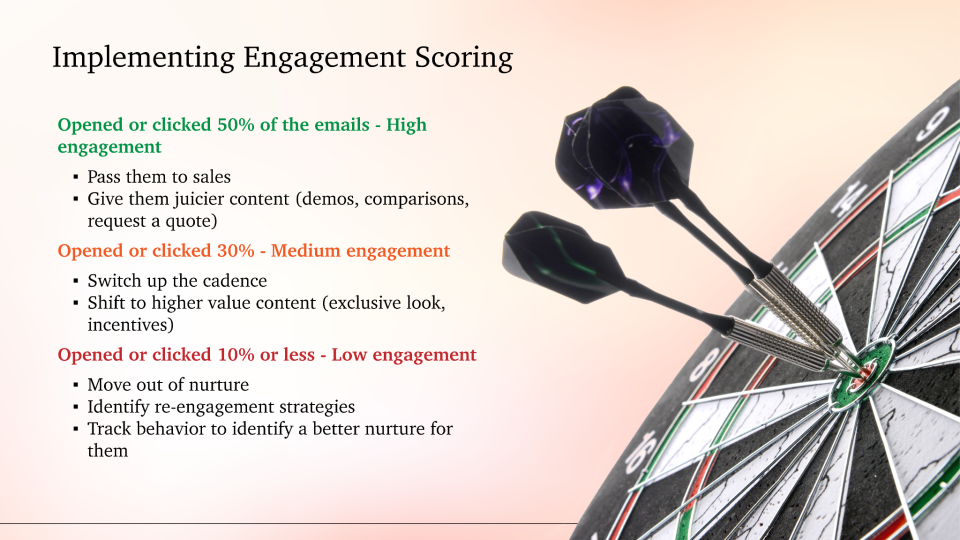
Her team is implementing engagement scoring to make this systematic. The logic is simple:
- Opened or clicked 50%+ of emails: high-engaging. Pass to sales or send deeper content.
- Opened or clicked around 30%: medium engagement. Adjust cadence or try a different stream.
- Opened or clicked 10% or less: move them out, find a re-engagement opportunity, keep tracking.
The point is not to be Big Brother (her words, not ours, though also kind of her words). The point is to stop losing high-engaging readers somewhere in the funnel. It happens more than it should.
Three things you can actually do today
Run an evidence swap
Open your last email. Find the most vague claim in it. Replace it with a data point. Not every claim. Just one. "Get better responses" becomes "Get 10x better responses." "Our customers love us" becomes "87% of customers are repeat buyers." Start there, do it legally, and build from that.
Treat subject lines as labels, not ads
Do not clickbait your expert audience. They will not trust you again. Seriously.
What works: specific outcomes ("How to cut X% off your testing time"), honest questions ("How does this affect your workflow?"), real trade-offs ("What you gain, and give up, with this technique"), direct problem-solution framing ("Why most A/B tests produce poor results, and how to fix your setup"). Describe what they get when they click. Do not tease. Do not withhold.
Use the one useful thing rule
Do not summarize everything. Do not write the whole blog post inside the email. If you do, readers have no reason to click through. Give them one concrete insight or outcome they can act on or think about differently. One thing. That is the whole email.
The real payoff: a list that actually trusts you
Urgency does not work. Mystery does not work. Hype does not work.
What works is precision. Specificity. Treating readers as peers rather than prospects. Building a nurture system that earns trust across many touchpoints rather than trying to manufacture it in one.
The result is something rare in email marketing: a list that trusts you. A subscriber who knows you will not waste their time. That is not something you can buy with a discount.
Writing for experts is not about being hype. It is about being precise. And, as Castellanos says, being precise is how you build a list that lasts.
Articles to wet your whistle



.png)
Subscribe to our newsletter.
Dive into the world of unmatched copywriting mastery, handpicked articles, and insider tips & tricks that elevate your writing game. Subscribe now for your weekly dose of inspiration and expertise.