

The responsibility of reach: Cher Fuller at Unspam 2026
At Unspam 2026, Cher Fuller made one thing clear: having access to someone's inbox is not the same as having permission to use it.


You sent an email this week that you didn't think twice about. The subject line, the timing, and the fact that the person on the other end might have been in the middle of something. It went out anyway, because the calendar said so.
Cher Fuller has spent her career at brands like Alo, Nike, and Playboy, helping them reach millions of people. At Unspam 2026, the email marketing conference by Really Good Emails held in Long Beach this April, she took the stage as VP of Digital Experience at Vuori and said what a lot of email marketers are quietly thinking but rarely say out loud. Her talk was officially titled "I Want You to Stop Sending Emails: On Cultural Timing, Emotional Intelligence, and Knowing When Your Brand Doesn't Belong in the Moment." Provocative title. Earned every word of it.
Reach is not the same as relevance
She opened with a question: think about the last text you sent. You probably read it twice, softened the tone, checked the timing. You did that automatically because the message felt personal. Now think about how you approach your next batch send. Different story, right?
That gap is the whole problem. When communication becomes marketing, we stop asking the same questions we would ask a friend. We stop thinking about context. And context, it turns out, is doing most of the work.
Today, nearly 5 billion people are reachable through digital channels. Brands can respond in real time, jump on a cultural trend, or land in someone's inbox within minutes of a decision. That accessibility is genuinely unprecedented. But Fuller was clear: access to attention has never been easier, and knowing what to do with that attention has never been harder.
Reach is not relevance. Relevance is not permission. Just because a brand can join a conversation does not mean it should.
Two case studies: getting it right, and getting it wrong
The LA wildfires: when going quiet was the right move
Fuller shared a story from early 2025. She was working at Alo when wildfires swept through Los Angeles. At 4 AM, evacuation alerts were going off. Team members had lost their homes. Alo had set up a disaster relief station at its Beverly Hills flagship, handing out emergency kits to displaced neighbors.
And simultaneously, "Sweet Pink" was about to launch that week. Big deal. The girlies go crazy for pink.
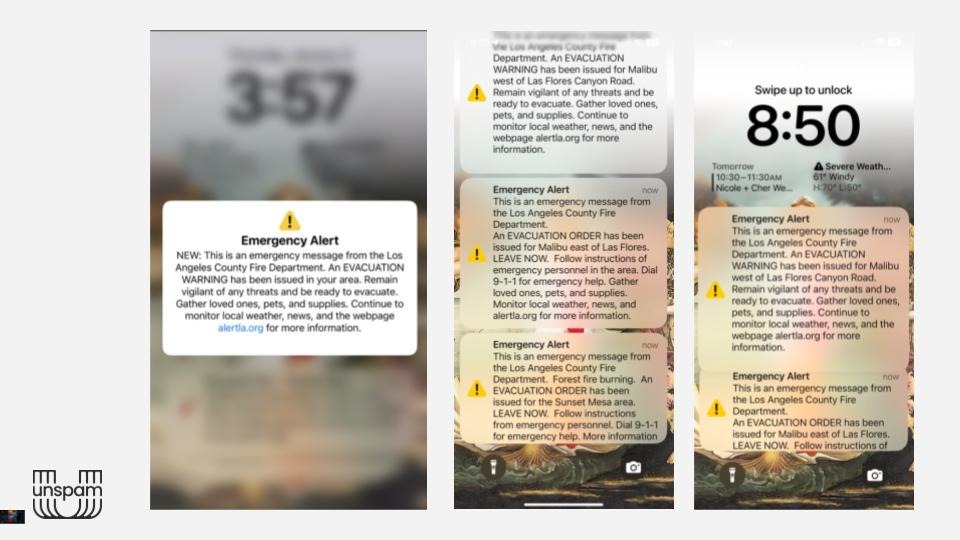
The call was to suppress the LA region from all sends entirely. Fuller was convinced they would miss their revenue targets. Instead, Alo exceeded its benchmarks for the week. The fires that felt catastrophic to her team were a small headline to the rest of the country. The thing customers remembered afterward was not Sweet Pink. It was that Alo had shown up in their community and had stayed quiet when quiet was the right choice.
When they did resume communication with LA customers, they did not pretend nothing had happened. They acknowledged the fires, said directly that they had gone quiet because it had not felt right to do otherwise, and then focused on being useful. Free access to Alo Moves, their wellness app. A place to exhale.

The lesson: leaving customers alone can be the most meaningful thing a brand does.
What's in it for you: suppressing a segment during a local crisis is not lost revenue. It is a trust deposit. And trust is the only currency that compounds.
COVID: when empathy became a template
The contrast was 2020, which most of us remember too well. Overnight, every brand you had ever interacted with arrived in your inbox. Health and safety are our top priority. We're here for you. We're all in this together. From brands you had not thought about in years, in some cases, brands you barely remembered giving your email to.
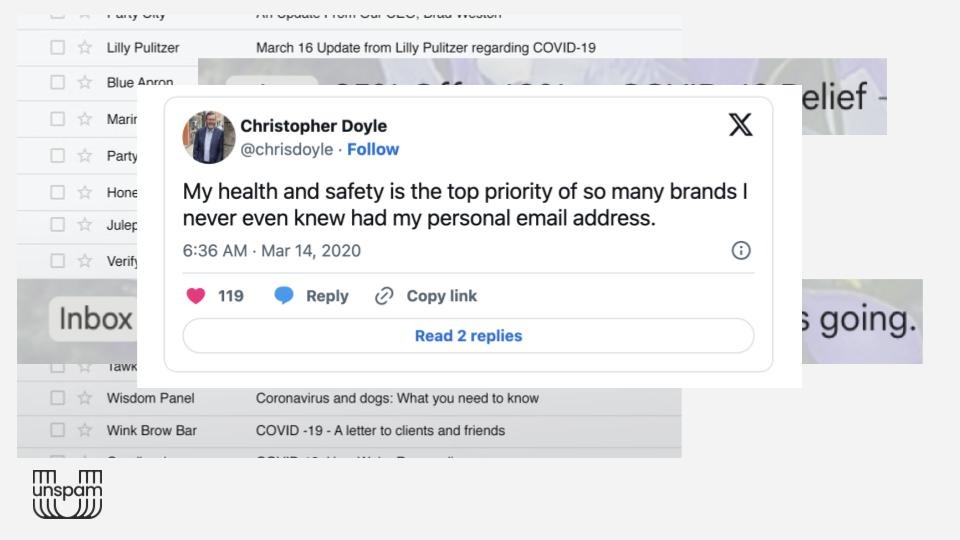
Brands were trying to do the right thing. But when every brand sends the same message at the same time, empathy becomes a template. Volume became noise. Noise became a distraction. Distraction became mass unsubscribes.
Most of those brands did not change their return policies, their customer support, or anything about the actual experience. They just generated more email. The result was the opposite of what they intended. Instead of building trust, they burned it.
What's in it for you: if your version of showing up does not change anything about the actual customer experience, it is not empathy. It is just volume with better copy.
A filter for knowing when to show up
Coming out of the wildfire experience, Fuller and her team built a set of questions to run through before deciding whether to engage in a cultural moment. Not a checklist to race through, more like a forcing function to slow down. The kind of thing that, once you have it, makes you wonder how you were making these calls before.
- Reach: Does this situation even affect our customers enough to warrant a response?
- Relevance: Does this message actually help the customer right now?
- Empathy: What context shapes how this content lands?
- Appropriateness: Should we be showing up here at all?
- Cadence: Are we already too loud? Are we adding to the noise?
- Human timing: Why now? Why does this need to go out today, to this person, who is already dealing with enough?
Six questions. Most brands skip all of them. 64% of customers say they want brands to connect with them emotionally, but connection requires reading the room first. Broadcasting good intentions without doing the reading is not a connection. It is just noise that means well.
Personalization is context, not just product recs
Fuller pushed back on the standard industry definition of personalization. Browsing history, location data, product recommendations: these are all fine, but they are the surface level. They tell you what someone clicked. They do not tell you what is going on in their life.
The deeper question is whether your brand actually supports what is happening for that person right now. 72% of customers say they only engage with personalized messaging. But personalized does not mean "we know you looked at that jacket." It means situational. It means timing. Sometimes, relevance is not what you say. It is entirely when you say it. The product is the same. The moment is what changes everything.
Worth sitting with: the next time you are mapping a segment, add one column. Not "what did they buy" but "what might be going on in their life right now."
Ruining the vibe
Fuller illustrated this with a moment from the same weekend as the conference. Justin Bieber streamed his Coachella set live on YouTube, and footage of Katy Perry's reaction to Bieber pulling out his phone to show her the YouTube stream mid-performance went viral. Her expression said everything. The vibe had been interrupted. Not by a competitor, not by bad weather. By a notification.
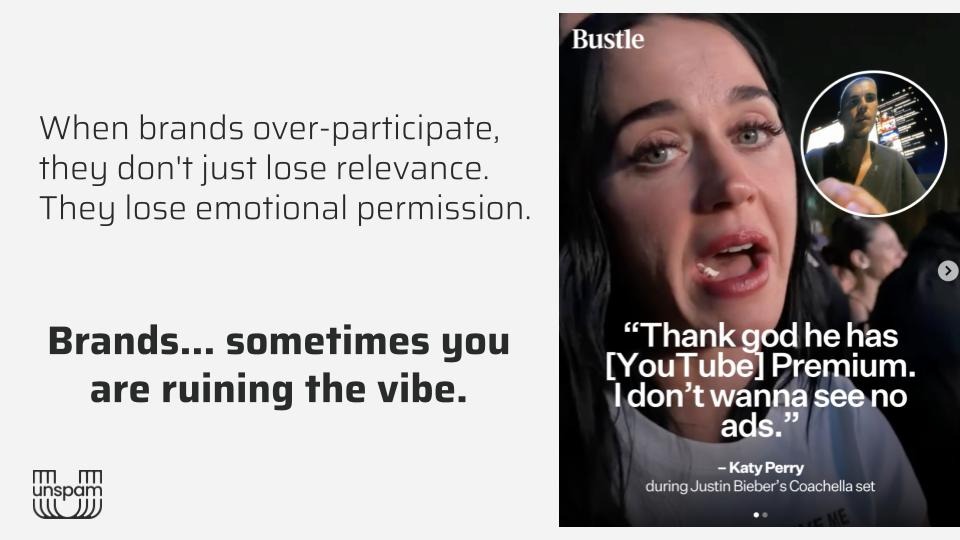
Funny because it was true. You are in the middle of something genuinely good, and an unnecessary message breaks the spell entirely. The brand, in that moment, became the thing that ruined it.
When brands over-participate in moments that belong to their customers, they do not just lose relevance. They lose emotional permission. And the cost is measurable: 44% of customers say they unsubscribe because content is not relevant to them. Once they unsubscribe, you do not just lose one campaign. You lose every message you would have ever sent them. Permanently. Because you were the notification during the Bieber set.
Alarm fatigue: what a labor and delivery nurse taught her about email marketing
This is where the talk got unexpectedly great. Fuller's best friend, Melissa, is a nurse in labor and delivery. When Fuller described her talk topic, Melissa immediately said, "Oh, that's alarm fatigue." Fuller had never heard the term. And then came one of those moments where two people in completely different fields suddenly realize they have been solving the exact same problem from opposite ends.
In clinical settings, nurses are constantly surrounded by alarms. Between 80 and 99% of those alarms are non-actionable. Over time, providers become desensitized. Response times slow. And when a genuinely critical alarm fires, it is more likely to be missed because it has become indistinguishable from the hundred that came before it.
Melissa described a specific scenario: a patient's oxygen saturation and heart rate, read together at a particular threshold, indicate an emergency requiring immediate intervention. That same combination triggers constantly for no good reason. It takes clinical judgment, not just the sound, to know when it truly matters. When everything signals urgency, urgency loses meaning.
Your customers are living this. Every day, they receive emails, SMS messages, push notifications, wishlist reminders, abandoned cart alerts, price drop alerts, event announcements, welcome flows, win-back campaigns, and appointment reminders. All day, from every brand they have ever interacted with. When frequency increases without relevance, 20% of customers disengage entirely. And once they have trained themselves to tune you out, getting back in is much harder than staying relevant in the first place.
Attention is a finite resource. Every message you send is either teaching your customers to notice you or teaching them to ignore you. Emotional intelligence in email is not about sending less. It is about the signal value. If everything feels urgent, nothing is.
What's in it for you: audit your sends this month. Not for performance metrics. For signal value. Ask yourself honestly: if a customer received only this email from us this week, would it feel like something worth opening?
Trust compounds over time
Fuller closed with an analogy that landed. A friend calls and asks you to help them move. You say yes the first time. The second time, fine. The third time in three weeks, you look at your phone, see their name, and put it face down.
Every send is doing the same thing. Training your customers on whether to pick up or ignore. They have a life. You are a small part of it. The goal is to be the part they are actually glad to hear from.
The brands that will win over the next decade are not the ones with the most reach. They are the ones who understand what reach costs actually are and what it is actually for. When brands show up with awareness and restraint, customers reward them with something a discount cannot buy: trust.
And trust, as Fuller put it, compounds over time.
Articles to wet your whistle




.png)
Subscribe to our newsletter.
Dive into the world of unmatched copywriting mastery, handpicked articles, and insider tips & tricks that elevate your writing game. Subscribe now for your weekly dose of inspiration and expertise.