

Email design workflow: from design system to sent
At Unspam 2026, Deja Cherese made one reframe stick: relevance is not a personalization problem. It is a design thinking problem.


You woke up this morning. Took a shower. Got in your car, started the engine, navigated to wherever you needed to be. None of those systems asked for your attention. They just worked.
That is how Deja Cherese, Senior Email Marketing Specialist and founder of Digital Deja, opened her Unspam 2026 session. And then she spent the next hour making the case that your email program should work exactly the same way: orchestrated, intentional, and running on a system that holds everything together even when nobody is watching.
Here is the framework she uses, and why most email teams have been solving the wrong problem all along.
The industry is obsessed with personalization. Deja says that's the wrong word
An email design workflow is the step-by-step process of making your electronic messages. Simple definition. Complicated reality.
Behind every email that lands in someone's inbox, there is cross-functional coordination, strategic intent, and a stack of design decisions that most people never think about. What makes an email actually work, Cherese argued, is not that it is beautiful (though that helps). It is that it is relevant. Right message, right person, right time, right format, right reason.
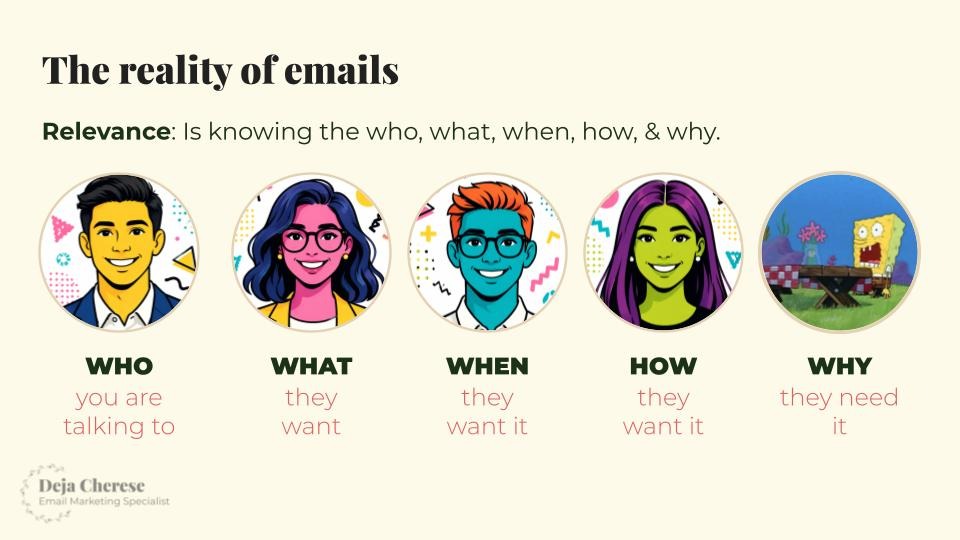
The email industry has a word for that. It calls it personalization. Cherese has a different word: design. Because relevance does not come from a merge tag. It comes from user research. And user research is design.
That reframe is the whole talk, really. Everything else builds from it.
Think like a designer. You do not need the job title
Designers are everywhere, she said. The ceiling in that conference room was designed. The chair you sat on was designed. Your shoes, your phone, the shape of the cup you drank coffee out of this morning — all of it went through someone who understood how humans think, feel, and move through the world before it ever reached you.
What great designers share across every medium is that they have mastered people. Psychology, physiology, motivation, aesthetics, and problem-solving. They are not just making things look good. They are solving for how things make you feel.
Email professionals can tap into the exact same capability. The framework is called design thinking, and it has five steps.
The five steps, and what they actually mean for email
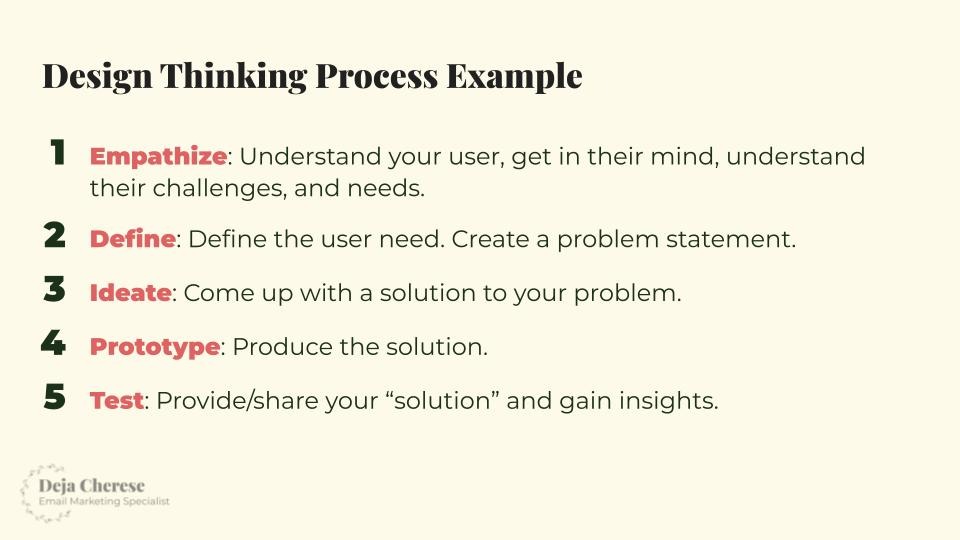
Empathize. Not your audience profile. Not demographics. Actually stepping into the brain of the person you are emailing and imagining the real friction in their day-to-day life. User journey maps, user profiles, qualitative research — the tools that make "audience understanding" concrete instead of vibes.
Define. Write a problem statement. One or two sentences. What is the actual problem this person is experiencing, and what solution are you promising to provide? If you cannot write that down clearly, the email is already in trouble.
Ideate. This is where design thinkers go wider than traditional marketers. It is not "let's add a discount code" or "let's A/B test the subject line." It is asking what tools, what interactions, what genuine value could make this person's situation better. The thinking gets big before it gets practical.
Prototype. Build the email. But also ask: does the journey this email creates actually deliver on the promise? Does the person land where they need to land? Is the experience end-to-end, or does it fall apart at the click?
Test. Not just did it hit the KPI. Did it solve the real problem? Did the customer feel good about the interaction? Are they coming back?
Two examples that make it click
Scenario one: sell fall coats for a retail brand. A traditional marketer starts with who to target and how many units to move. Design-thinking marketer starts with the friction: what does it actually feel like when the seasons change and your wardrobe no longer fits your life? That emotional starting point changes the strategy, the copy, the measurement, and often the result.
Scenario two: sell premium hockey seats. Traditional marketers ask who can afford them and how many touchpoints it takes to close. Design-thinking marketer asks what friction is making people hesitate, and how to frame the offer as a solution to that friction rather than a sales pitch. The goal is not urgency. It is confidence.
Same product. Different question at the start. Very different email at the end.
There are four levels of email design. Most teams skip straight to level three
Cherese laid out a progression that most email teams climb out of order:
Level 1: Core design principles. Visual hierarchy, balance, contrast, proximity, alignment, repetition, white space, unity. Not email-specific — just how humans visually process anything. Once you learn to name what feels wrong in an email and understand why, you can actually advocate for fixing it instead of just shrugging at your screen.
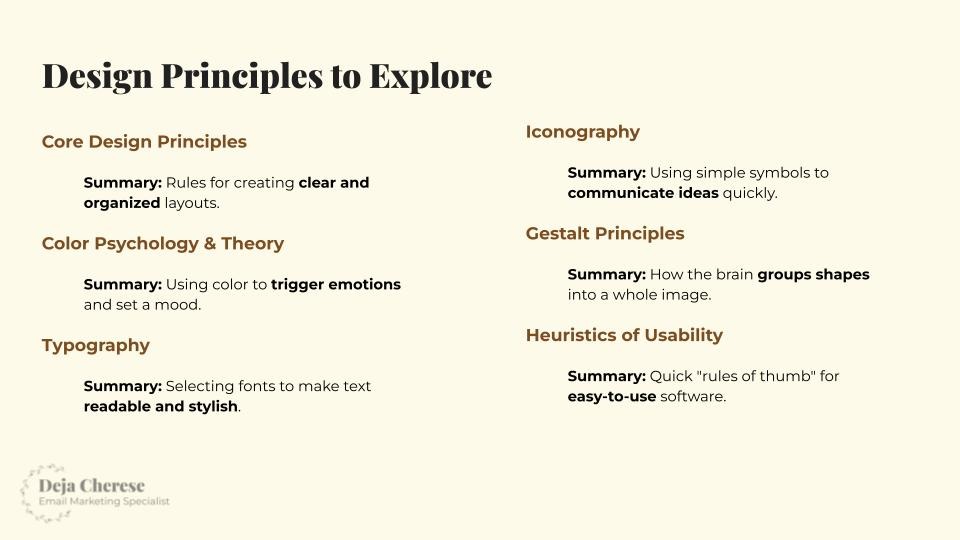
Level 2: Email-specific design principles. Applying those foundations within the constraints of email rendering, across clients and devices. This is where general design knowledge meets the specific weirdness of the inbox.
Level 3: Email templating. Where most of us live. Creating, managing, and updating templates. The day-to-day reality for most email teams, and usually the first thing anyone learns.
Level 4: Design system maintenance. This is where the real leverage is. And most teams never get here.
Every email in the world is made of five things
Colors. Text. Containers. Links. Images. That is it. Stack enough of those together, and you get something that looks like a nav menu or a hero module or a product card. The complexity is an illusion. The anatomy is always the same.
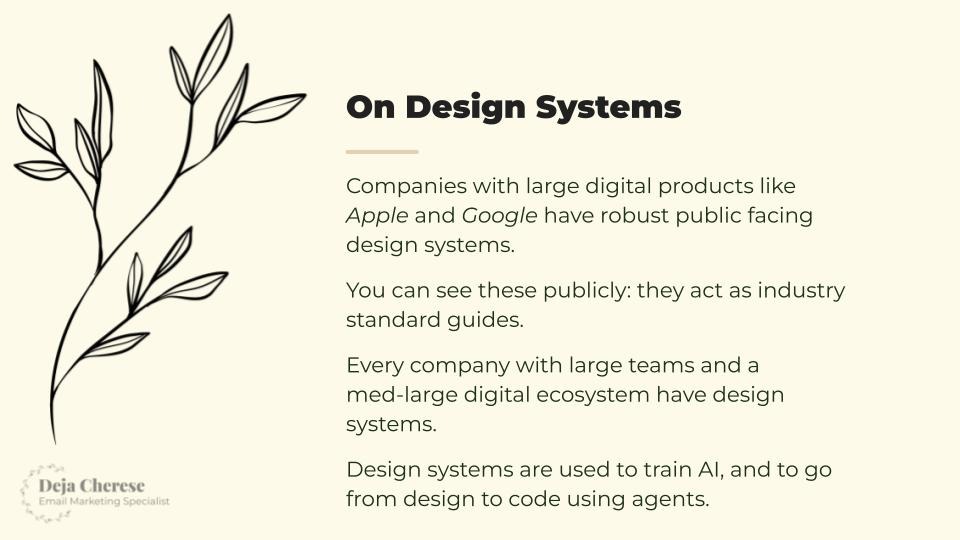
A design system is a centralized library of components, built and documented so that everyone on your team — marketing, design, development, data — can work from a single shared source of truth. It makes building faster. It makes consistency automatic. It makes onboarding new people not a disaster.
Cherese was direct about where the industry stands: if your team does not have a design system, you are probably behind. But here is the good news. If your company already has one for web and app (which most established ones do), email does not need to start from scratch. You piggyback on what already exists and build out the email-specific layer on top.
And then there is the AI angle. If you want to train an AI agent to generate or redesign emails, it needs a centralized library of components and tokens to learn from. Your design system is not just an organizational tool. It is the infrastructure for whatever you are trying to do next.
How to actually start: the four-step audit
Audit your workflow. Map every person who touches an email from first idea to final send. Who are all the people? All of them. Because they probably all need to be involved.
Audit your email program. What types of emails do you actually send? In what proportions? What layouts do you already have? Get the full picture before you build anything new.
Audit your email design. Go through your brand guidelines and your email library. If the whole program feels too large, start with one email type and expand from there.
Build and document. Use whatever tool your organization allows. But do not skip the documentation step. Design systems that are not actively maintained become memory on a hard drive. Nice memory. Useless memory.
How to use AI inside the design thinking process
Once the mindset is in place, Cherese had a practical suggestion for putting it to work immediately: use AI as a thinking partner, not a copywriting shortcut.
The prompt structure she recommended has five parts. Give the AI a role. Provide context about your brand and your users. Give it a specific task. Tell it exactly what output you want and in what format. And give it a framework to work within — in this case, design thinking.
Then ask it to do something most people never try: generate two strategies for the same brief. One from the perspective of a traditional marketer. One from the perspective of a design-thinking marketer. Put them side by side and see what changes.
That comparison is the exercise. Not to copy either strategy wholesale, but to train your brain to notice the difference between a campaign that starts with the product and one that starts with the person. Do it a few times, and the design-thinking questions start showing up on their own, before you ever open a brief.
It does not stop at the inbox
One thing worth noting: Cherese did not limit the design thinking framework to email work. She spent the closing minutes of her talk making the case for applying it to your personal career, too — defining your own problem statement, designing your personal brand, writing a career statement that gives you a clear filter for the decisions you make.
Her own: "I want to do great things with great people." Simple enough to test every situation against. Hard enough to actually mean something.
It is a small addition to an already dense talk, but it lands. Especially in a room full of people who are often the only one on their team doing what they do.
What to take with you
Email is a design problem, not a production problem. The teams that get better results are the ones that spend more time understanding the person before they spend any time thinking about the email.
Design thinking is not a creative luxury. It is a practical system for asking better questions before the brief is written, the copy is approved, and the template is built. And if your team is operating without a design system, that is the most concrete place to start — not because it is the flashiest initiative on the roadmap, but because it is the infrastructure that makes everything else, including AI, faster and more consistent.
You do not have to be a visual designer to think like one. You just have to be willing to start with the human before the email.
Your shower worked this morning. Your car started. None of that happened by accident. Neither does a good email program.
Articles to wet your whistle




.png)
Subscribe to our newsletter.
Dive into the world of unmatched copywriting mastery, handpicked articles, and insider tips & tricks that elevate your writing game. Subscribe now for your weekly dose of inspiration and expertise.