

Keep marketing weird: how PostHog refuses to market like everyone else.
The most data-obsessed company in martech runs its brand on gut, good vibes, and one little hedgehog.


Here's a fun contradiction to sit with. PostHog sells analytics. Their entire pitch is stop guessing, measure everything. They built a $1.4 billion company on that idea.
And yet the part people actually love, the hedgehog and the weirdness, is the one thing they don't really measure. It runs on gut.
I sat down with the two people most responsible for keeping it that way: Lottie Coxon, PostHog's lead graphic designer and first creative hire (she posted her portfolio on Twitter and got a DM from the founder 24 hours later), and Joe Martin, employee number ten, first marketing hire, and, in order, a former clown, morgue cleaner, chainsaw salesman, tech journalist, content consultant, and product marketer. So, normal résumés all around.
What follows is less a playbook and more a permission slip. Here's what I took from it.
First, the one rule they'll never break
I asked what they'd never do for the brand, no matter how good the payoff.
Joe didn't hesitate: “Host a webinar.”
Lottie tried to steal his answer. That's the energy we're working with. This is a company that describes its own brand voice as “playful” (Joe) and “unfiltered” (Lottie), and means both as compliments.
The tell isn't the webinar joke, though. It's why they can make it. When you've built a brand people genuinely like, you get to say no to the boring stuff everyone else does out of obligation; that's the whole prize.
There's a deeper rebellion under it, too. Early on, an exec told Joe flatly that email marketing doesn't work for developers. He built the nurture campaigns anyway, then spent the next few years cheerfully reminding her she was wrong. If your audience is technical — hello, everyone selling software to engineers — tattoo that somewhere. “Email doesn't work for our audience” is a story people repeat until someone bothers to prove otherwise.
See it in the wild: PostHog's product onboarding email literally opens with “No webinars or sales fluff, just tips.” It's a developer email that reads like a human wrote it — the anti-webinar stance isn't a bit for the podcast. → PostHog product launch wizard email
They didn't rebel against the playbook. They never read it.
I went in assuming PostHog was a company of rule-breakers. Conscious rebellion. Zig while everyone zags.
Turns out that's not quite it.
For the first two or three years, Joe was the only marketer at PostHog with actual marketing experience. Everyone else was a former engineer or came from a totally different corner of the world. So when I asked what playbook they set out to ignore, Joe's answer was basically: we didn't know the playbook existed.
You can't throw out conventions you never learned. That flipped the whole conversation for me. The most distinctive brands aren't always built by rebels. Sometimes they're built by people who simply never got handed the rules.
That said, the ethos was deliberate. Lottie put it plainly: when everyone goes right, we go left. When corporate SaaS was cranking out white papers, PostHog's instinct was never make one, or, if they had to, print it on toilet roll. Because sameness is invisible. Do what everyone else does and you're just shouting into the same void they are.
And they refuse to blend in right down to the type. Their first font was literally Lottie's handwriting, called Loud Noises. The current marketing font is a custom job named Squeak. I did not make either of those up.
The hedgehog is an 18-time redraw (and now he has eyebrows)
Max the Hedgehog has been through 18 versions. He's named after developer advocate Phil Leggetter's kid, in a conversation Lottie describes as suspiciously short given how much legacy is riding on it.
Before Max, the mascot was… humans with TV and computer monitors for heads. Lottie shot that one down. It felt aggressive. Oppressive. Not human. Which, if you've ever received a cold B2B nurture sequence, you'll recognize as a real design problem, not just an aesthetic one.
The bar Lottie holds is this: cover the logo, and you should still know it's them. (Sound familiar, email people? If you've got a dozen sub-brands or regional teams sending under one masthead, that's the whole job: a brand consistent enough to survive with the logo cropped out.)
And Max earns his keep. My favorite example: the Managed Data Warehouse launch. Data warehouses are not sexy. So the campaign leaned all the way in: Max in six-inch transparent crystal heels, on a stripper pole, under the headline “Columns in all the right places.”
That went live. This is a real analytics company.
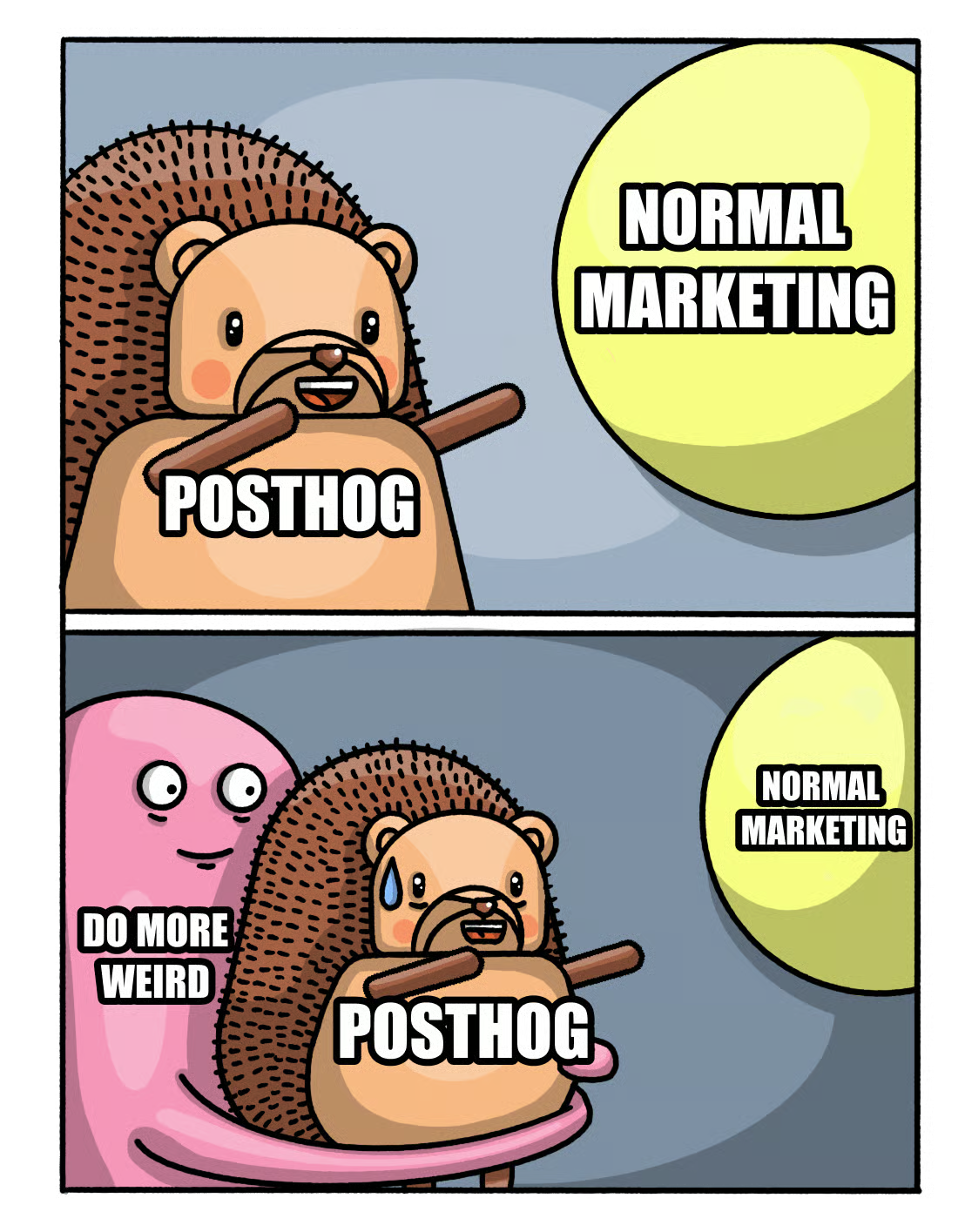
“Do More Weird” — but the emphasis is on do
There's a Slack channel called Do More Weird. I assumed it was an idea graveyard where wild pitches go to be admired and never shipped.
Wrong. Joe was firm: the point isn't the weird, it's the do. You socialize the idea, get buy-in, and then you just go build it. You don't need anyone's permission to do more weird.
The whole company runs on ask-forgiveness-not-permission, which is seemingly terrifying and also clearly working. Someone in billing is currently trying to build a PostHog mobile phone network, apparently, and nobody is stopping him.
They also have a second Slack channel called Mistakes Were Made. When someone messes up and has to roll something back, they get quietly added to it, not to be shamed, but to land in a room full of people going “yeah, been there, don't worry about it.” Over time, Joe points out, everyone gets added because nobody doesn't make mistakes.
That's the safest possible version of a company that ships fast. Move quick, break a thing, get folded into the group chat of people who've also broken things.
The brand test that isn't a metric
PostHog sells data, but Lottie describes brand success as purely qualitative. It just works. I wanted to know how they square that.
So I pushed. Doesn't that bother you?
Joe told me about a test he ran. He pulled Lottie's Max illustrations out of the marketing emails and dropped in clean product screenshots instead. Did click-through drop? Did anything change?
Lottie's art won. By about 1%.
But here's the kicker: Joe concluded the test itself was the mistake. His take: this is art; it's worth doing because it's worth doing, and running the experiment at all slightly missed the point.
Coming from the marketing lead of a data unicorn, that's not anti-data. It's the difference between data literacy and data worship. You measure what you can. Then you have the taste to know when the number isn't the story.
Lottie framed brand the way I wish more people did: it's water dripping into a bucket. No single drop moves the needle. It's the consistency, over a long time, that builds the thing people know and love. Which is also, and I say this constantly, exactly how a good email program works. You don't earn the sale on message one. You earn it on drip forty.
How weirdness actually pays the bills
Because someone always asks whether any of this drives revenue, here's the receipts:
- PostHog is the #1 deal on Y Combinator's internal deals platform, ahead of much bigger companies. A big driver? The merch. Including an “emergency business tie” founders can keep in a desk drawer for when a shareholder swings by.
- Founders in San Francisco email Joe every week because they saw someone wearing a PostHog t-shirt and wanted one.
- A salesperson flew to Japan to strengthen a Fujifilm relationship, handed over a pile of Max plushies and some custom Godzilla-x-PostHog business cards, and Fujifilm cited the mascot as a core reason they loved PostHog, product aside.
As Lottie put it, the purpose was never the outcome. Be memorable in a delightful way, and the business follows. Marketing's oldest lesson, and somehow the one everyone forgets.
Case in point: they'll happily send a product-update email under the headline “We're a fashion brand now” and route you straight to the merch store — changelog and all. → PostHog is now a fashion brand email
The rebrand nobody will announce
PostHog is mid-rebrand right now. And their approach would give most brand teams hives.
There's no agency, no launch date, no big reveal in the works. When I asked how they'd announce it, Lottie shrugged: “It's just gonna appear one day.”
Most brand teams would need a lie-down after hearing that.
The logic holds, though. Joe's point: in the R&D stage, a rebrand is low-stakes work. Spend a year playing and making mistakes, and you haven't wasted a year; you've used it well. The product is the thing on center stage. The brand can take its time.
Their values evolve on the same patient clock. Every couple of years, at the company offsite, they re-litigate what they actually believe. “Everybody codes” used to be a value. They dropped it because, as Joe put it, an artist at PostHog shouldn't aim to be the worst engineer. They should aim to be the best artist.
That line is the whole ballgame for a lot of marketing and design teams. Your best email person is so often stuck being a mediocre coder, fighting a builder designed for engineers, waiting weeks for a developer to ship one campaign, watching the brand leak quality on every handoff. PostHog's move was to stop asking the artist to code and start letting them make. If your email program bottlenecks on the one or two people who can actually wrangle the platform, that's the same problem wearing a different hat, and freeing those people up is the quietest, highest-leverage glow-up there is.
What they said to steal
I always end by asking what listeners should take home. Their answers:
Joe: Hire more artists — everywhere, not just in design. And be radically transparent. PostHog publishes almost everything: their launch conversations, their goals, their marketing strategy, all out in the open on GitHub.
Lottie: Give people autonomy. Let them cook when they think they're onto something.
Strip away the hedgehogs and the toilet-roll white papers, and you get to what Joe and Lottie actually believe: people buy from people. PostHog leans into the actual humans who build it because that's the part AI can't fake. AI can hold a lot of data and mimic a sense of taste. It cannot have a gut instinct you'd trust, or empathy, or the nerve to put a hedgehog on a stripper pole and stand behind it.
My takeaway
The neat, quotable ending is that PostHog built a billion-dollar company telling everyone to measure everything, and got there by mostly not measuring the best part.
But the honest takeaway is a little more uncomfortable. Their brand governance isn't a process you can copy-paste. It's a hiring filter. They screen for taste and for people brave enough to hold a bold, possibly wrong opinion, through paid “Super Days” where candidates do a real day of simulated work. Which means all of this is only replicable if you're willing to pay the cost of hiring that way.
That's freeing, honestly. The weirdness is available to anyone. You just have to actually choose it, and then keep choosing it, every day, under pressure. Personality isn't a campaign you run once. It's a posture you hold.
Now go build your version of the hedgehog. 🦔
Catch more from Jacqueline: She hosts Making Sense of Martech, the show that goes further down the Martech rabbit hole and tries to make sense of it. Watch full episodes on YouTube or dig into the archive at msompod.com.
Articles to wet your whistle




.png)
Subscribe to our newsletter.
Dive into the world of unmatched copywriting mastery, handpicked articles, and insider tips & tricks that elevate your writing game. Subscribe now for your weekly dose of inspiration and expertise.