

Nonprofit welcome emails: turning subscribers into supporters
Whatever your first-time donors did before they gave, nudge new subscribers to do the same.


The best welcome series I ever helped build was actually for a telecom, rather than a nonprofit. We built the automation around five or six key behaviors people needed to do in their first 90 days, because the ones who did them were more likely to stay longer as customers.
That's what got me thinking differently about nonprofit welcome emails.
Many nonprofit welcome messages say thanks for signing up, add a row of social icons, and stop. They're built to make people feel welcome, not to lead them toward the actions that come before a first gift. This is a missed opportunity.
Here's my core content strategy idea for a nonprofit’s welcome series: whatever actions most of your first-time donors took before they gave, start nudging new subscribers to do the same things.
That's it. And there's a lot you can do with that idea.
Lead them toward what your first-time donors already did
Your development team probably already knows what signals to monitor.
If over the years you’ve found that people who come to an in-person event are more likely to give, then the welcome needs to invite them to an event. If people who volunteer tend to become members or donors, the welcome needs to make volunteering opportunities easy to find.
If your team isn’t sure, try this:
- Pull a group of subscribers from a past year: some who went on to give or join, and some who didn't.
- Look at what each group did in their first 30 to 90 days. Events, topics clicked, volunteer shifts, replies.
- Find the actions that separate the two groups.
- Make those actions the calls to action in your welcome. Then check whether pushing people toward them actually changes who converts.
The first welcome message: Put your best foot forward
Let’s be realistic. If one person at your org runs email, social and the website, and helps with the annual gala (and cleans up afterwards, too), then y’all might not have time for a multi-touch welcome series. I’d design one really good welcome note and stop there.
Keep it simple. You can add a second or third message six months from now. Not everything needs to be perfect on day one.
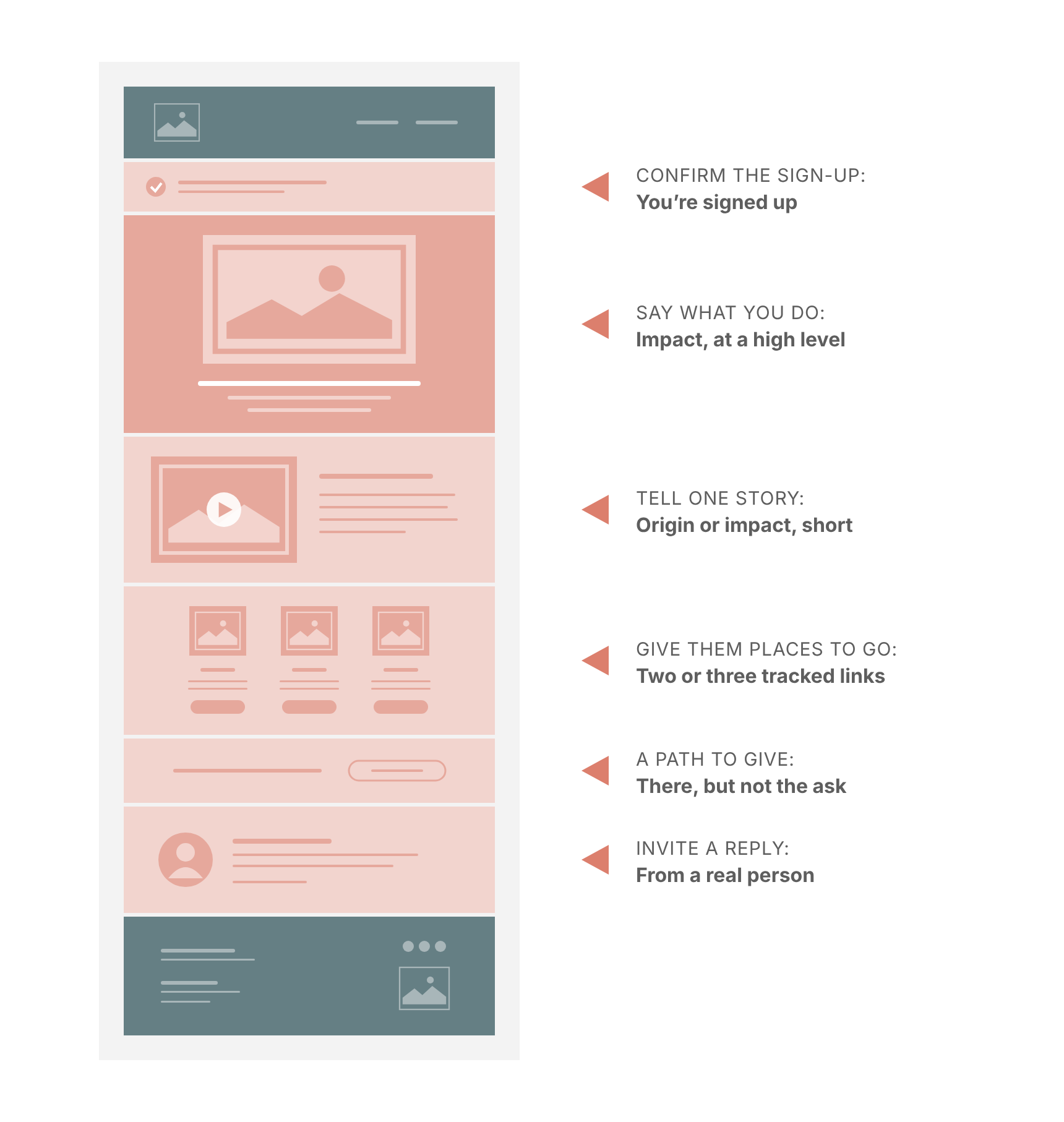
That one message should do a few things:
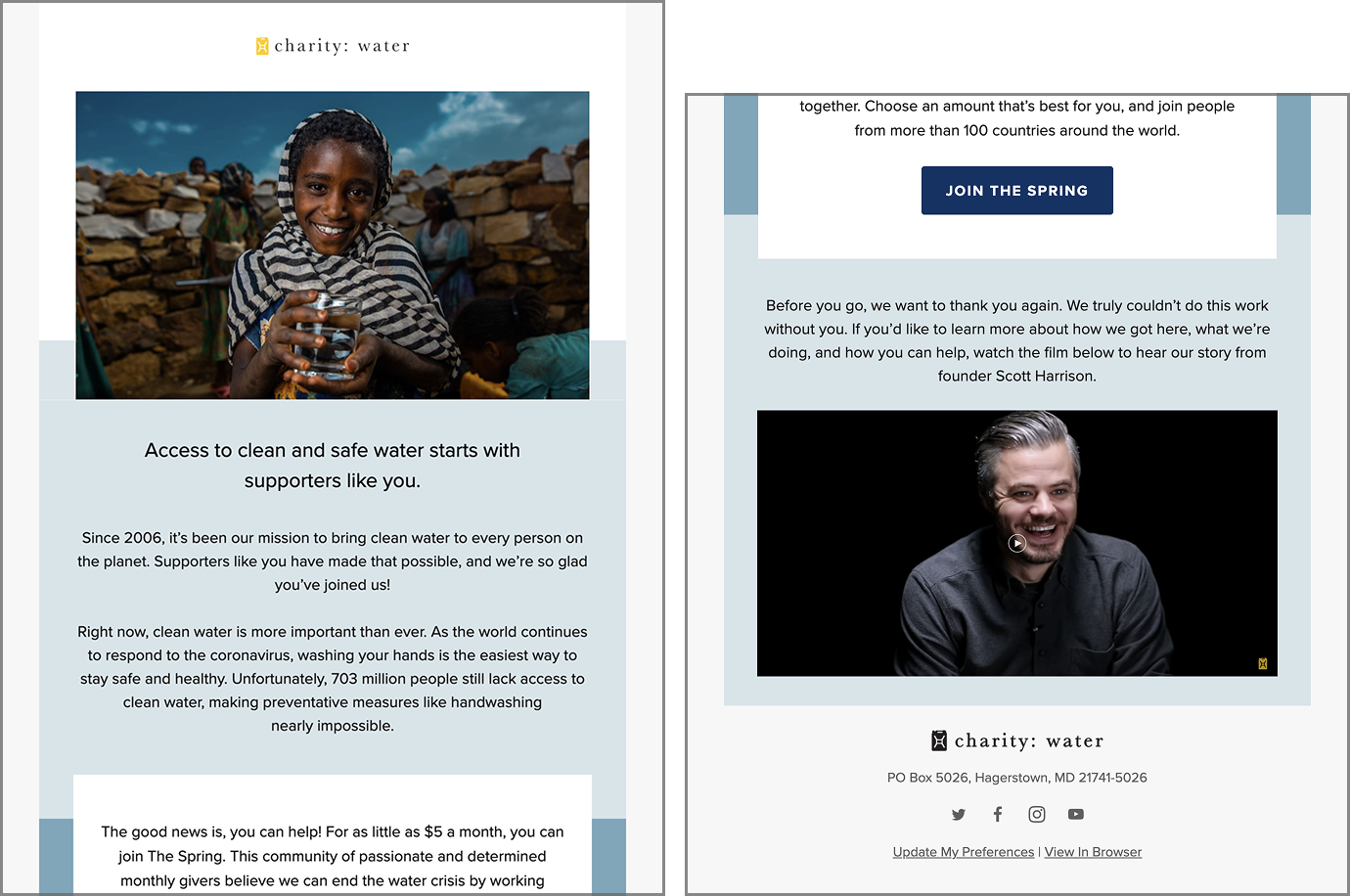
- Confirm the sign-up. Before any storytelling, a welcome has a transactional job. The person clicked submit and is wondering whether anything happened, so say it in a line or two at the top: you’re signed up, here’s what you’ll get, how often, and who it’s from. It shows you’re organized enough to handle their email, which builds trust. Then watch the bounces and unsubscribes on that first send.
- Say what you do, at a high level. A lot of organizations have a singular, strong mission, but the way it gets carried out may in fact be complicated. If you try to explain the “how” too soon, new people get lost fast. Simplify your opening message, back it up with one story of impact or fact, and always share your ethos.
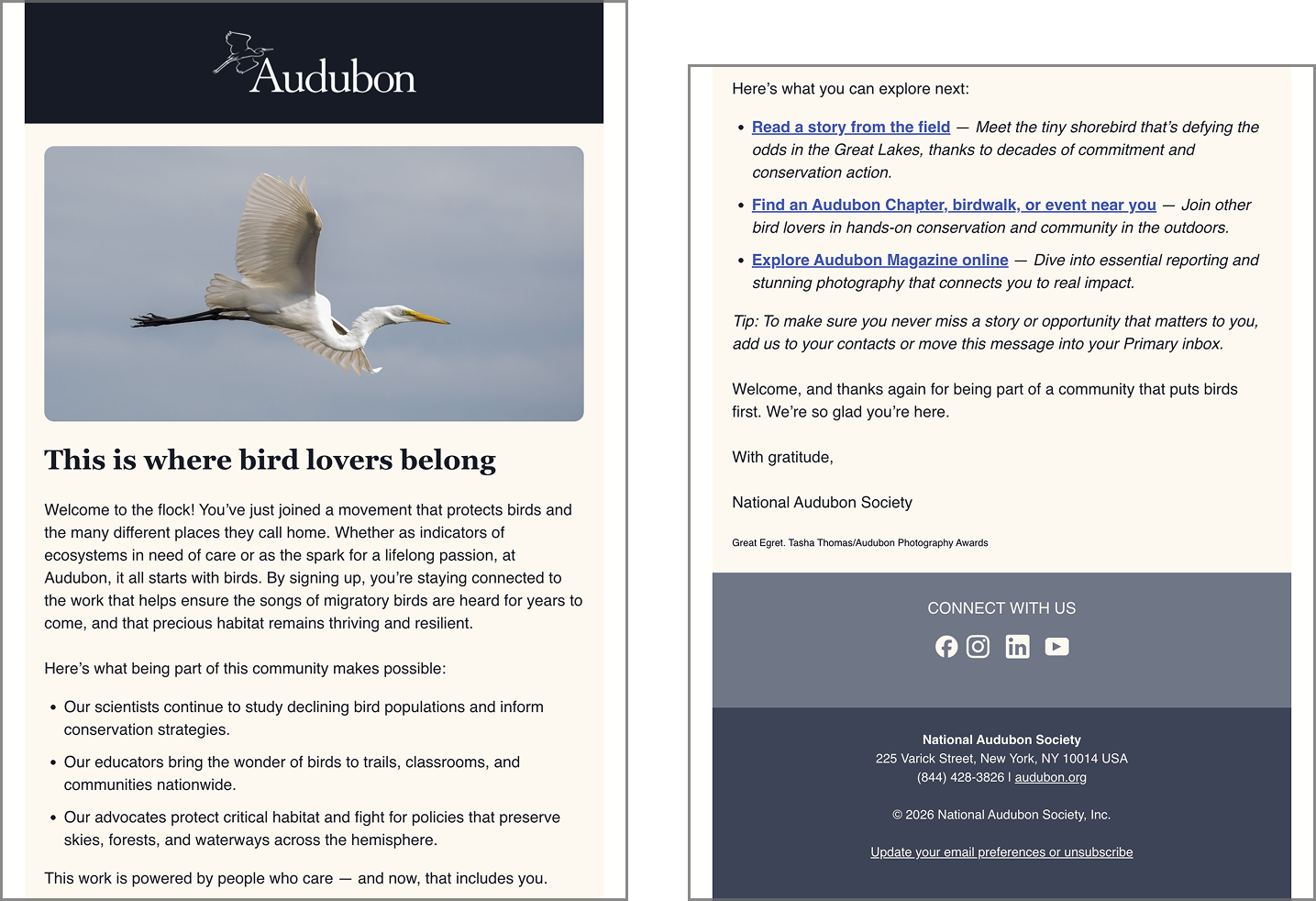
- Give them places to go. Two or three links into distinct parts of your work: a program, an issue, a place, a person. Each click is a signal you can track for later segmentation.
- Always create a path to give, without making it the ask. Every message should have a way to give, though not every message needs an ask. In a welcome, engagement now matters more than asking now. Let new subscribers know that just by showing up, they’ve taken a key step toward making an impact. If they can’t give yet, offer small ways to help, like watching a video or sharing a story with a friend.
- Invite a reply. "Hit reply and tell me what brought you here" starts conversations a button never will. The best feedback I’ve ever seen on a welcome email came from a short personal note in the voice of the CEO. More than one reader replied: “Hey, I know this is probably automated, but I really appreciate this note!” To their surprise, the CEO would write back: “I know! But it’s exactly how we feel.” More often than not, a relationship would begin.
Multi-touch welcome series: Use it to learn more about each other
How long is a welcome series? I recommend three messages, each with a different job:
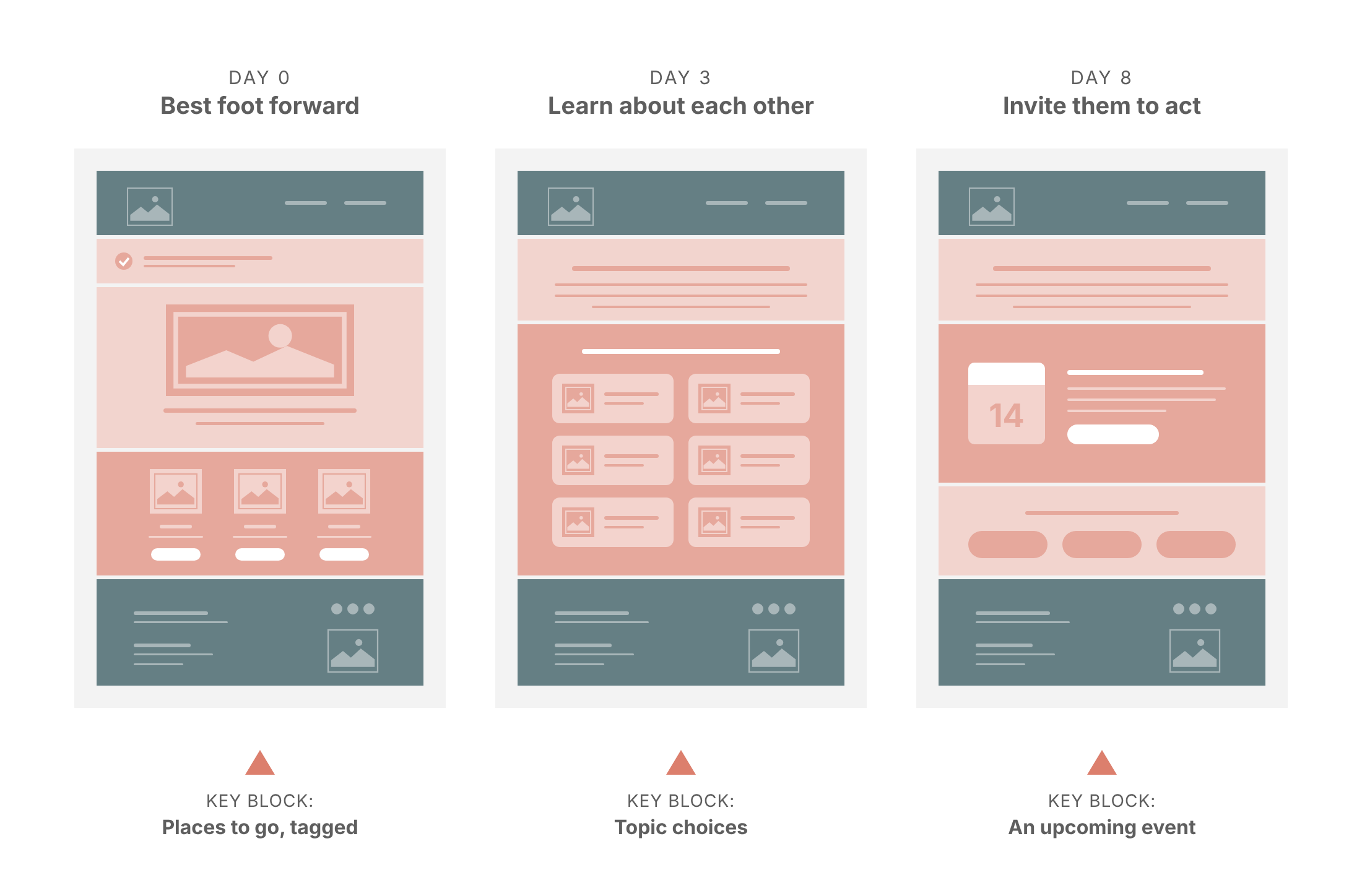
Message 1 - Best foot forward. Everything in the single message above. If you can, tag content and append clicked topics to the subscriber’s profile.
Message 2 - Let’s learn about each other. This is the data collection piece. From a pure marketing standpoint, I want to know what their connection to your mission is, and this may be the best chance I get for a while.
Offer a few distinct topics to explore, or ask one short question about what they care about most. Tag every click to their profile. A short quiz works well here too.
For an independent radio station, we suggested asking new subscribers to name three artists they love, then recommending several YouTube live performances back to them in a triggered response. It fills in their profile at the same time.
Message 3 - Invite them to act. An event, a volunteer shift, a first gift, chosen based on what message two taught you. If you have a live calendar on your website, see if you can feed an upcoming event into your email.
A few practical notes:
- Shorter is fine. In one test of a nonprofit welcome series, sending the first email dramatically lifted response to the second, but the second did little for the third. Three good messages beat five thin ones. It’s how I landed at three.
- Timing. You want that first note arriving nearly instantly. After that, a pattern I’ve used is three emails across a little more than a week (days 0, 3, and 8). Hold newsletters and appeals until the series ends. You’ll have plenty of time to make your asks in the future.
- Tag your content. Give every story a theme (an issue, a program, a voice people connect with) and tag the reader when they click it. It’s how a welcome starts building a profile instead of just sending a message. New to this? Pick one topic tied to a campaign you’d like to run later, like your recurring giving program. Here's more on detecting donor passions through email behavior.
- Let them choose. New subscribers often feel they have little control over what they’ll get or how often. If you offer more than one newsletter, the welcome is the place to show them the menu.
Know where they came from
Where someone opted in tells you something about them before they click a single link.
I recently read research on art museum members that found a person’s reason for joining helped predict whose relationship would later stall. People who got a membership as a gift, or who joined at an event loosely tied to the museum’s mission, were less likely to stay engaged. Drift often starts at the welcome. A thoughtful welcome is your first chance to steady a shaky connection before it has time to drift away.
So, I suggest recording the source on their profile from day one, and letting it shape the first message.
A quick note on soft opt-ins. By “soft opt-in,” I mean people you met and added to your list yourself: someone from a conference, a coffee, or a site visit who you believe would care about your mission.
In the US, that’s generally allowed. CAN-SPAM, the US email law, doesn’t require opt-in consent the way SMS rules do, though you must always give people a clear way out. The bigger limits are practical. Most email platforms require permission in their terms of service, and spam complaints from people who don’t remember you will hurt deliverability for everyone else on your list.
Outside the US, check first. The rules are stricter in the EU and Canada, and the UK now has its own charity soft opt-in, in effect since February 2026, with conditions that may not match what I’m describing here. This isn’t legal advice, so if your list is international, talk to your privacy lead before adding anyone.
If you do add people this way, put them in their own segment and open their first few messages with a short note: you’re getting this because we met recently, and if you’d rather not hear from us, no hard feelings, here’s how to unsubscribe.
Then watch that segment closely. If someone hasn’t clicked or replied after a few months, take them out of your regular emails. The one exception I’d make is your annual impact report.
Getting the tone right
There's a tension in every nonprofit welcome. Your leadership needs you to raise money, right now. Your job is also to find their connection to your mission. The welcome is where those two jobs meet for the first time, so it's worth deciding what the vibe should be before anyone opens a template.
Guilt or Optimism? Guilt is a real lever, and plenty of appeals pull it. What you’re looking to do is to show how someone can help make an impact. Optimism and invitation fit the moment better. A 2023 meta-analysis of 26 studies found guilt had only a small persuasive effect overall, working better when it spoke to a general wish to make things better than when it made the reader personally responsible, and better when the problem was clearly fixable and the next step was clear.
Plain or polished? A lot of nonprofits believe their email and other marketing materials shouldn't look too nice, as if good design proves they overspent or wasted resources. I’ve overheard this discussion numerous times with different nonprofit leaders. I disagree (vehemently, to be honest). A welcome is the first time that a donor or member prospect has specifically asked for more information, and you need to look organized and intentional.
There's real evidence, however, that there’s value to keeping your branding “light.” NextAfter has multiple tests where plain, letter-style emails beat designed templates on appeals.
My read on these tests: when the job is a gift from one person to another, plain wins. When the job is a first impression of the whole organization, polish earns its place.
Should the welcome messages be from a person or from the organization? It depends on what's authentic to you. If the CEO of McDonald's welcomed you to the drive-through, that would be strange. If a nonprofit founder who's still in the day-to-day fight to support their mission wants to tell, in their own words, why the mission matters, that's a great story, and you should use it.
- Small nonprofit, and people know you? Lead with the person. Video works well here, too.
- National? Make it local. I’ve noticed many large nonprofits working nationally will ask for my zip code or region, but then their welcome doesn't address local or regional issues.
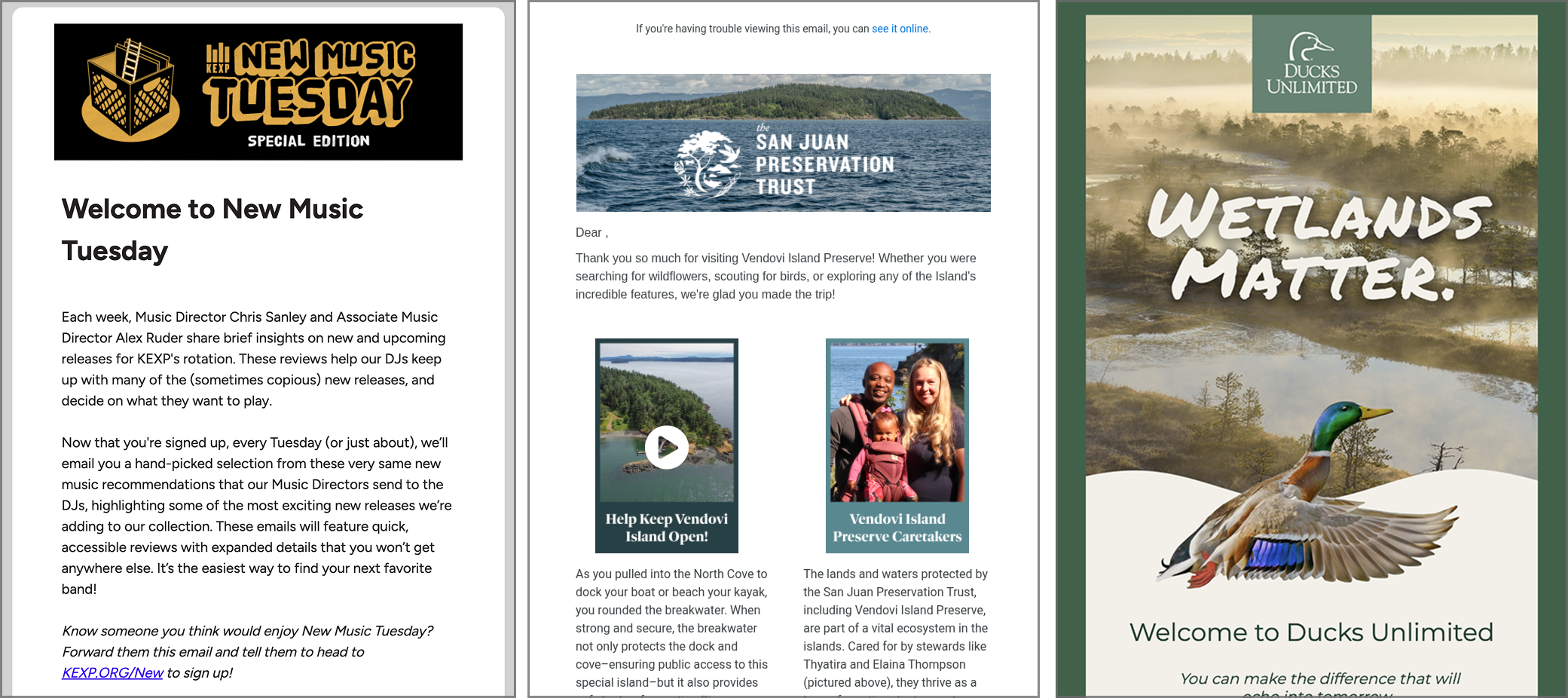
Use the language of your supporters, but keep it simple and easy to read. Use the language of your supporters, and keep it simple. Write the way your supporters talk, not the way your strategic plan reads. You’re not writing this for your board. You’re writing it to people who don’t yet really know you.
That matters even more as more and more of your readers speak English as a second language. Translation tools have a hard time with figures of speech, and new people rarely know your acronyms. So skip the jargon, clichés, idioms and metaphors. They’re the first things that make a welcome feel like it was written for insiders.
What to report on
A welcome isn't done when it sends. Look at its performance quarterly, or at least once a year:
- Who is signing up, and how many.
- Where they're coming from: which page, which event, which soft opt-in list.
- Bounces and unsubscribes on the first send, which tell you whether bad addresses are getting in. (Do you have a double opt-in set up?)
- How many convert to a first gift or a membership, and how long it took.
- What they're interested in, based on the topics they click.
- Who replied, what they said, and whether anyone wrote back.
Pull this together into a report and pass it along to your leadership and development teams.
A short list that says "these people signed up this spring and keep clicking on a specific topic" is worth more to a development team than any open or click rate.
What we want to do is build relationships, and inside those new subscribers are real people who took a chance on your organization. Paying attention, understanding what they value, and not rushing things can go a long way toward winning their hearts and support.
Articles to wet your whistle

Subscribe to our newsletter.
Dive into the world of unmatched copywriting mastery, handpicked articles, and insider tips & tricks that elevate your writing game. Subscribe now for your weekly dose of inspiration and expertise.