

Unsubscribes are data, not defeat
At Unspam 2026, Fernando Rubino Pereira made the case that unsubscribes are data, not defeat. Here is the KPI most teams skip and the soft opt-out that turned churn signals into a loyalty program.

You know that feeling when your database is shrinking, you are sending four emails a week, and someone in the meeting says, "Let's just increase frequency a bit more"?
Yeah. That happened.
Fernando Rubino Pereira, CRM Marketing Expert at METRO AG, opened his Unspam 2026 session with a live poll. He asked the room how they felt about unsubscribing. Fifty-three percent said, "Curious, I want to know why." He called that a healthier starting point than panic. Then he spent the next thirty minutes walking through a real case study from a previous role at a global sports brand, where the team was doing everything wrong, knew it, and still could not stop because the pressure for short-term revenue was louder than the data.
Here is what they tried, what flopped, and the strategy that turned churn signals into a loyalty program.
Why email teams ignore unsubscribes (and what it actually costs)
The honest answer is that subscribers feel like rejection. We look at open rates, click rates, and revenue. We hide the rest.
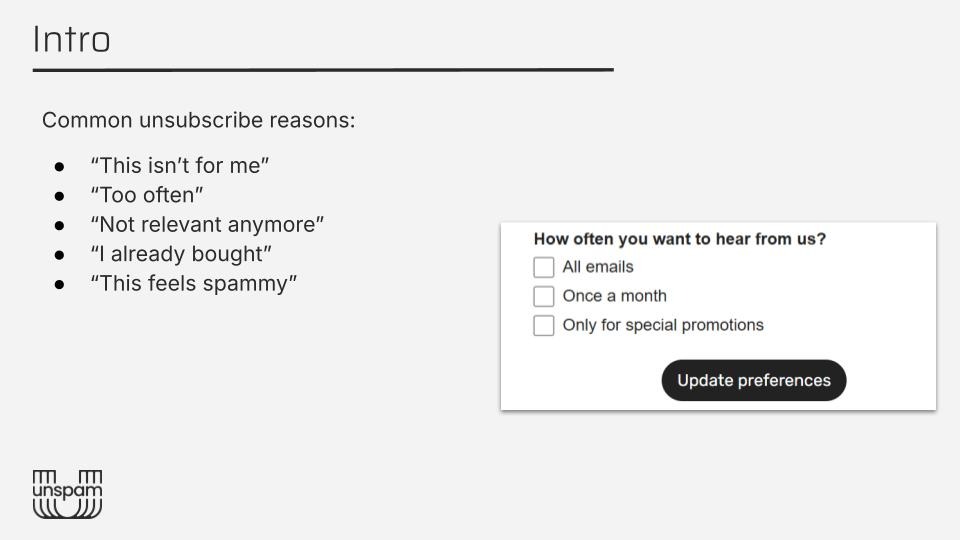
Fernando was direct about it: his team was removing the unsubscribe KPI from board presentations entirely. Not forgetting to include it. Actively taking it out. And when subscribers stopped opening, the standard response was to quietly suppress them rather than ask why they had disengaged in the first place.
Fernando put a number on what that actually costs.
Take a conservative lead acquisition cost of $10 per subscriber, which he noted is on the low end. Plenty of companies pay $50 or more. Now run a blast campaign that generates 500 unsubscribes. That is $5,000 in lost acquisition spend, gone. And almost no one reports it that way.
The standard post-campaign report shows revenue. It never shows the loss column. But if your lead gen team is paying real money to build the list while your sends are burning it down, you are running in place and calling it growth.
The benchmarks worth knowing
Before the case study, Fernando gave the room two numbers to calibrate against.
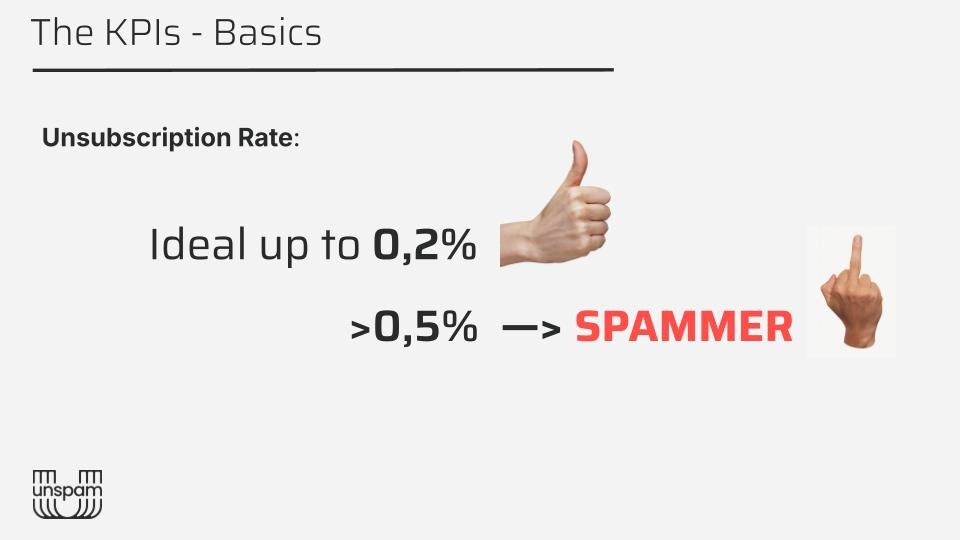
The ideal unsubscribe rate is 0.2%. That is the threshold at which a thumbs-up is warranted. Cross 0.5%, and you are in spam territory, not just strategically but reputationally. "More than 0.5, we can call you a spammer," he said. "Nobody here wants to be named a spammer."
Spam complaints are a separate and stricter metric. When a subscriber hits "report spam" in Gmail, Outlook, or Yahoo instead of using the unsubscribe link, that registers as a complaint. The acceptable ceiling is 0.1%. Anything above that, and you are likely already experiencing deliverability problems with that provider, even if your dashboard has not caught up yet.
The KPI most teams skip: list growth percentage
Fernando's most useful framework was the list growth percentage. Simple math, underused metric.
Take your subscriber count at the start of the month. Add new subscribers. Subtract unsubscribes and pauses (contacts your ESP has suppressed or bounced out of the active pool). Divide by your starting count. Multiply by 100.
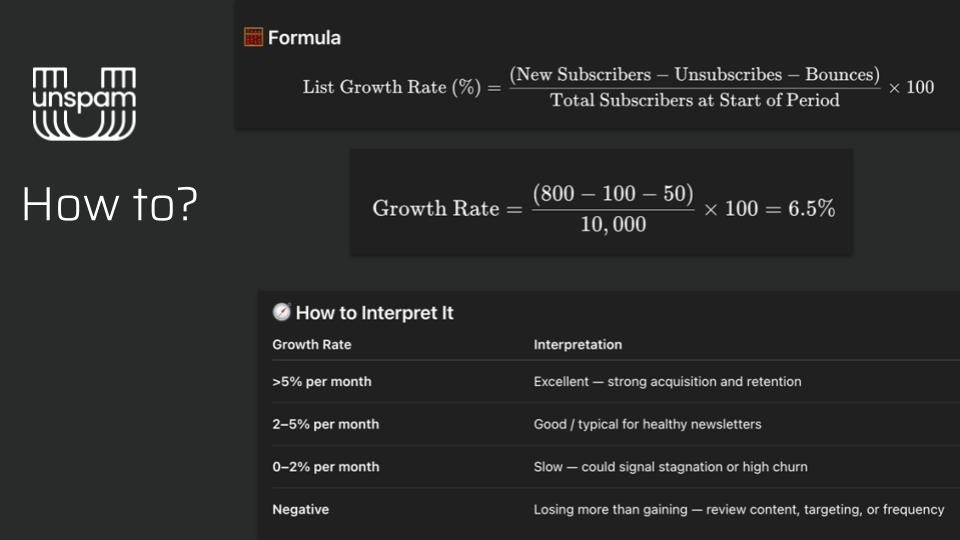
What you get tells you everything:
- Above 5%: You are genuinely growing. Acquisition is outpacing churn. Keep going.
- 2 to 5%: Solid, with room to improve. Worth examining the friction on both ends.
- 0 to 2%: Slowly moving. Your database is almost stagnant.
- Negative: You are losing ground. This is the number that woke Fernando's team up.
His team was in negative territory for months and did not realize it until they started tracking this number monthly. It took three months to turn it around. The KPI made the problem visible before anything else did.
Two strategies to reduce unsubscribes (one worked, one did not)
When the team finally confronted the numbers, they did what most teams do. They panicked, blamed frequency without evidence, and launched two initiatives at once. Fernando called them "smart strategies" with audible irony. They were guesses dressed up as plans. "That's not optimization," he said. "That's just guessing."
Strategy 1: the preference center campaign
The idea was solid. Build out a proper preference center, fix the data architecture, connect it to the ESP, then send a campaign asking subscribers what they actually wanted to receive.
They invested heavily in the infrastructure. They gave subscribers real choices: frequency, day of the week, and content type (sales, product launches, events). They sent the campaign.
Less than 10% responded.
Fernando was candid about why. People do not answer surveys unless there is something in it for them. A benefit, a reward, a result they get to see. "I don't like to answer surveys unless there is a benefit," he said. "Otherwise, I won't do." The preference center worked fine. The campaign did not, because asking for input without offering value in return is still an ask.
The lesson is not that preference centers are useless. It is that the campaign mechanism needs a reason for people to act. Without one, even a well-built infrastructure generates silence.
Strategy 2: the soft opt-out
This is the one that worked.
Instead of asking subscribers what they wanted before any issue arose, the team added a content block directly above the unsubscribe link in each email. Three categories: sales, events, and product launches. Two actions per category: thumbs up or thumbs down.
The logic was simple. If someone was already headed toward the unsubscribe link, give them a smaller exit first. Let them opt out of a category rather than opting out of everything. A thumbs-down on events meant they stopped receiving event emails but stayed on the list for everything else. They were not lost. They were just correctly routed.
The team ran extensive A/B testing across different category combinations and placements before committing to the format. Every time the block was included, the number of unsubscribes went down. Final result: a reduction of up to 10%. For a database that was shrinking month over month, that number mattered.
But the more interesting result came from the thumbs-up data.
What to do with positive opt-in signals
Most teams treat a soft opt-out as a churn prevention tactic and stop there. Fernando's team went further.
They analyzed who was actively signaling interest in each category, then built campaigns specifically for those people. The segmentation was already done. The audience had self-selected.

Here is what that looked like in practice:
Sales
Subscribers who thumbed up on sales content received higher frequency sends in that category. But the team also built early access campaigns and trackable vouchers specifically for this segment, so they could measure whether the higher engagement was actually converting. It was.
Events
This was the most successful category. Subscribers who signaled interest in events did not just get event emails. They got VIP invitations and real-world experiences that, as Fernando put it, "money couldn't buy." The brand worked in sports and sponsored professional athletes. Subscribers who raised their hand for events could end up meeting one of those athletes in person.
These people showed up. Not as clicks. As human beings, in physical spaces, because an email had earned that.
Product launches
Sampling invitations. Beta programs. Product launch events. The positive signal became the trigger for a loyalty loop that extended well beyond the inbox.
The framing Fernando kept returning to was this: the thumbs down was about not losing people. The thumbs up was about finding the right ones and doing something real with them.
The non-negotiables
Fernando spent time on compliance and visibility because he has worked for global brands and learned every relevant law the hard way. CAN-SPAM in the US, GDPR in Europe, CASL in Canada, and the Spam Act in Australia. They are not the same document. They do not have the same requirements. And if you send globally, you are subject to all of them at once.
The unsubscribe link needs to be visible. Not light gray text. Not 6pt font. Not black text styled to look like body copy that does not actually link anywhere. He showed real examples of all three in his slides. None of them was hypothetical.
There is a meaningful difference between an unsubscribe and a spam complaint. An unsubscribe is a clean exit. A spam complaint is a signal to the mailbox provider that you should not be trusted. If you hide the unsubscribe link, you are not keeping people on your list. You are pushing them toward the option that hurts you more.
Removal also needs to be automated and verified. Most ESPs handle this now, but bugs happen. Manual list uploads still exist. Whatever your process, confirm it works. An unsubscribe that does not take effect is not just a bad experience. In most markets with meaningful privacy laws, it is a legal liability.
The framing that held it together
Fernando closed with something that did not come from a spreadsheet. You do not need everyone. You need the right ones.
Most email programs are optimized to grow the number. More subscribers, bigger database, higher reach. But if the people you are adding are the wrong fit, and the sends you are doing are pushing the right ones out, the number is a fiction. It tells you how many people you have, not how many people actually want to be there.
The teams that figured this out stopped hiding the unsubscribe KPI from the board and started using it to make better decisions. The subscribers who stayed were more engaged. The KPIs that actually mattered improved. And the loyalty programs built on positive opt-in signals were doing something the blast sends never could: creating a reason for people to show up.
Not in the inbox. In real life.
Articles to wet your whistle




.png)
Subscribe to our newsletter.
Dive into the world of unmatched copywriting mastery, handpicked articles, and insider tips & tricks that elevate your writing game. Subscribe now for your weekly dose of inspiration and expertise.