

AI Manifesto
Since 2014 we've been working on one question: what makes digital content good. AI changes what our tools can do, and with it, what good means. Here's how we're using it at Beefree and Really Good Emails, and where we draw the line.
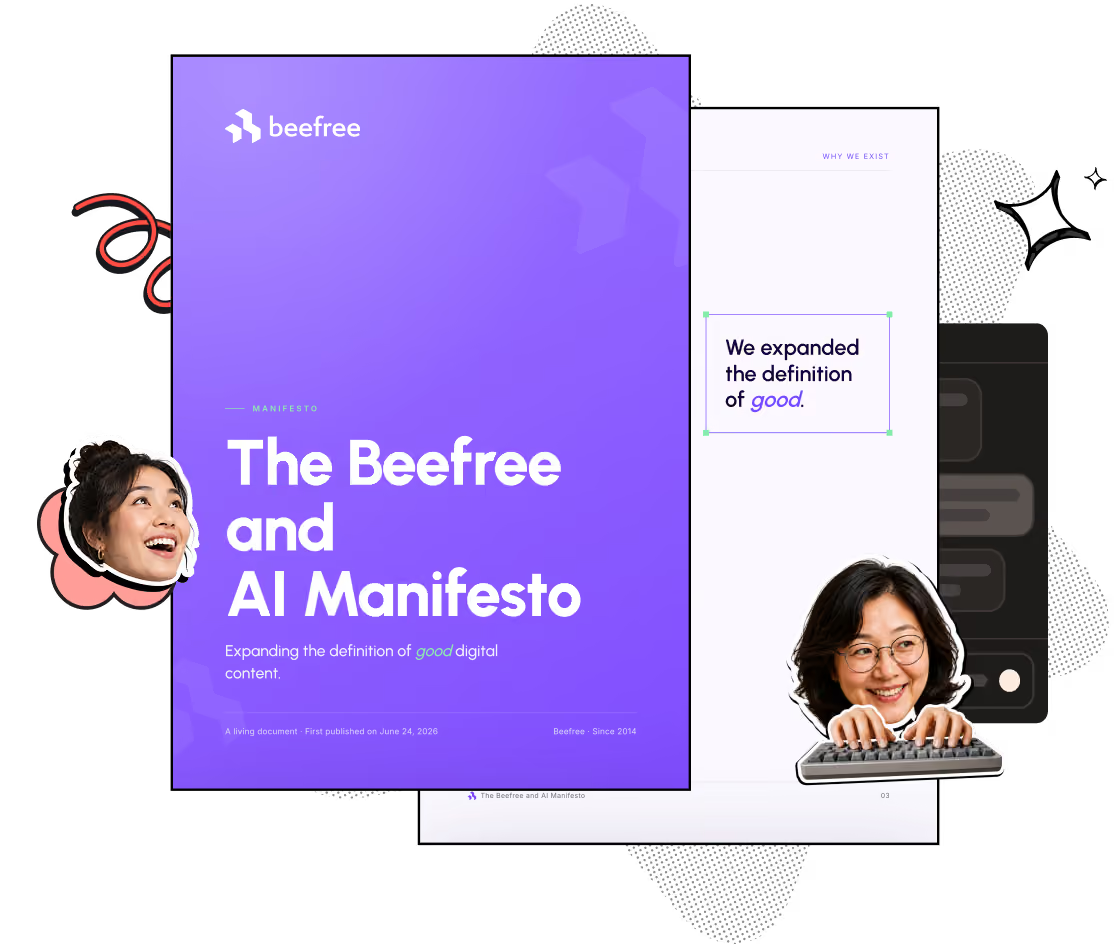
Why we exist
Digital content is key to the way people communicate. Since 2014, Beefree's mission has been to help more people create good digital content, with a particular focus on email.
When we started, by good we mostly meant consistent with design best practices, responsive on mobile devices, and displaying as expected.
Over the years, we expanded the definition of good to include ways to comply with brand guidelines, fix problems, and produce more accessible content.
We added new dimensions to good with Really Good Emails: celebrating excellence that inspires others through a curated email gallery, research, events, and community.

We expanded the definition of good.

AI can help advance our mission.
Why we use AI
Artificial intelligence can expand what our tools are able to do, and with it, what good means.
A few examples to illustrate the point:
AI allows natural language interactions, no matter which language our customers speak.
It can help diagnose and fix issues based on rules they set.
It can show inspiration related to the content they are working on.
It can flag off-brand design elements.
There are many others.
We believe that, as a result, AI can help us advance the mission we've pursued since we started, enabling more people to create better content.
How we use AI
We are aligned with Human-Centered AI (HCAI), the discipline intent on creating AI systems that amplify rather than displace human abilities.
It's the application to artificial intelligence of human-centered design, which prioritizes the needs, values, and experiences of people.
HCAI is a broad discipline. We have intentionally decided to focus on three key principles, expressed here in our own words, which can be our constitution.
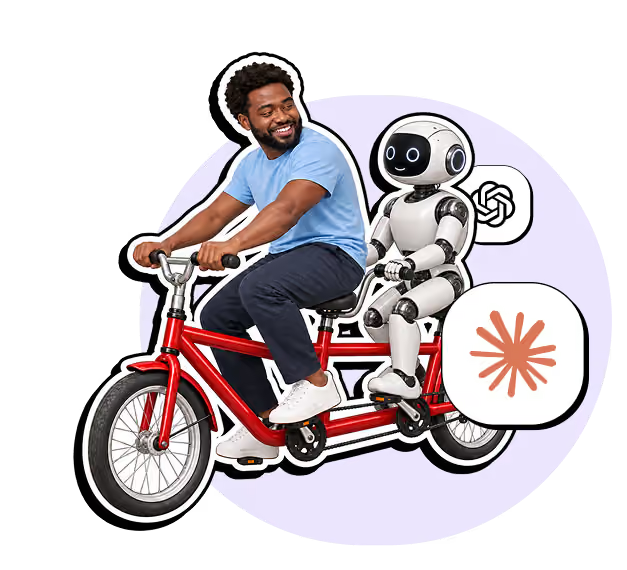
Collaboration between humans and AI
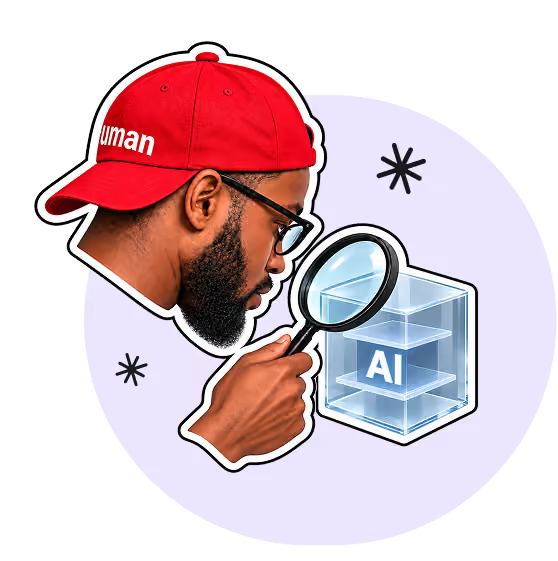
Explainability and traceability
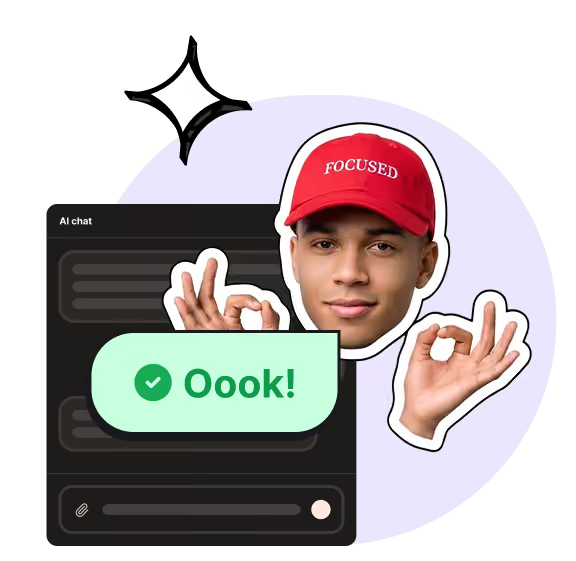
Human accountability
How this shapes what we build
We see Beefree and everything it creates becoming a human-centered, AI-augmented content creation platform. Our goal is to help create better content at scale while keeping people in control. As AI expands what our tools can do, it also broadens what good digital content can mean.
Earlier in this page we mentioned a few practical ways in which good becomes broader. We are committed to exploring and bringing to market product improvements to make that possible.
We will prioritize alignment with this manifesto over speed to market.
The product roadmap will evolve as capabilities do, so we are intentionally not setting it here. The principles in this manifesto are our current best thinking, but we expect them to evolve too, as we learn, as the technology advances, and as the regulatory landscape develops.
We commit to revisiting this document regularly and openly, and, when it changes, to communicating how and why.
Glossary
Human-centered design
Noun, practice. Human-centered design is a design philosophy and practice that starts with the people who will use a product, not the technology behind it. It prioritizes understanding users' needs, mental models, and contexts before defining solutions. The process is iterative: prototypes are tested with real users, insights feed back into design, and the cycle continues. It contrasts with technology-centered design, which starts with what's technically possible and works outward. More on HCD? See IDEO, What is Human-Centered Design? or the foundational ISO 9241-210 standard.
Human-centered AI
Noun, HCAI, discipline. Human-centered AI applies the principles of human-centered design to the development and deployment of AI systems. Where traditional AI research has focused primarily on capability (making systems more accurate, faster, more powerful) HCAI asks a prior question: does this system actually serve the people using it? It was formalized as a discipline by researchers including Ben Shneiderman at the University of Maryland, whose 2022 book Human-Centered AI laid out the framework. HCAI calls for AI systems that amplify human ability, support human oversight, and remain controllable even as they grow more capable. More on HCAI? See Stanford HAI and the seminal Shneiderman, Human-Centered AI, OUP, 2022.
Augmentation
Noun, approach. In the context of AI, augmentation refers to using artificial intelligence to enhance what a person can do rather than to replace what they do. An augmenting system handles the parts of a task where speed, scale, or pattern recognition give it an advantage, freeing the human to focus on judgment, creativity, and context. The distinction matters: automation removes the human from the loop; augmentation keeps them in it. Research shows that augmentation-style human-AI collaboration often produces stronger outcomes than either humans or AI working alone, particularly for creative and knowledge work. More on augmentation? See Licklider, "Man-Computer Symbiosis," 1960 (the foundational text). For current data, see the AI Index Report 2026, Chapter 4.
Traceability
Noun, property. Traceability is the ability to follow the origin and history of something through a process: knowing where it came from, what happened to it, and who made decisions about it along the way. Applied to AI, it means being able to see what a system did, with what inputs, and at which step. In a content creation workflow, traceability means that at each stage (drafting, editing, reviewing, approving) the people involved can see what the AI generated, what a human changed, and what was left untouched. That visibility is what makes meaningful judgment possible: you can only truly own a decision if you know what you're deciding on.
Human accountability
Noun, principle. Human accountability means that a person remains responsible for the outcomes an AI system produces. It's the principle that AI can assist, recommend, or automate, but when something goes wrong, there is always a human who owns the result. This matters because AI systems can fail in ways that are hard to predict, and diffuse responsibility ("the AI decided") is both ethically insufficient and, in many jurisdictions, legally untenable.